Analytics header

Showing posts with label software. Show all posts

Tuesday, February 5, 2019

The return of custom built manufacturing software

Is it really happening? Are the new digital technologies making it attractive and maybe even necessary to develop custom manufacturing systems solutions? For years we have advocated that companies focus on their core business competencies and leave the software development to expert best in class software companies. There are many horror stories of companies that are stuck supporting custom built software that is running their critical operations, why build and spend millions maintaining in house developed systems?

With the emergence of new digital technologies I see companies once again opting to develop custom software to solve their manufacturing systems needs. Is it because it is the 4th industrial "revolution", or is this truly something to consider, does it bring value and if so how? I believe there are a number of forces at play that are causing this to happen.
  • Emerging digital technologies specifically cloud based SaaS solutions provide user friendly ways to solve some specific problems like analytics and integration with very quick ramp-up times. I.e. you don't need a lot software development skills.
  • There is a real business need to get the promised productivity gains from these digital technologies. In other words organization have allocated money and people to get things moving in their digital transformation
  • The new generation of workforce comes from the digital age (i.e. digital natives) and are used to in simple words, just download an app for that. They are confronted with what they see as antiquated software systems that are not really user friendly and their reaction is to find another app.
  • The new digital technologies in general are human centered - they are developed to solve (and support) what we as people do, where as traditional business software is developed to automate a process.
  • The current solution landscape of available digital technologies, in what we know of as the manufacturing system domain, is very fragmented and somewhat immature. Yes there are pieces of it specifically in the Cloud part that are further along but in general no.   
So, is this a case of history repeating itself? Will we see a resurgence of home grown solution that we will in a few years pay dearly to replace with available software form industry suppliers? I am not going to try and be a futurist but I think we can apply some logic to what the future can bring.  So in general, yes I think so - although it will be different (what an ambiguous answer). There will be some level of custom software being built but at the same time there are some forces at play that are different from what we have seen in the past, and these will make a big difference.

The rate of software development and how fast it is maturing is much greater that it was in the past, and the new technological landscape will consist of a network (or mashups) of different systems.
We will not have specific monolithic systems for each department or business function. The future digital factory will be supported by a network of Cloud and Fog (or Edge Computing) software components that will have been put together from the bottom up. The future manufacturing systems will develop and mature over time thru emergence rather than a top-down design and development process. Think about that - if this is true so much of our current approaches will not work (GAMP, ISA-95/88, etc.)!

So much for my prediction of the future, PS no AI used here 😉.

Saturday, January 26, 2019

What is the Fog, and why does it matter?

Its not Karl the fog, but the industrial Fog! In news recently is the joining forces of the Industrial Internet Consortium® (IIC) and the OpenFog Consortium® (OpenFog). While manufacturers are still grappling with new technologies related to the new digital world (i.e Industry 4.0 and Smart Manufacturing) here comes another concept out of left field. So I guess the question is what is it and why does it matter right now, how will this bring me to the order of magnitude productivity increase.

Nobody said revolutions and transformation are easy, they require moving forward into the unknown - something us engineering have a really hard time with. Good news, there is no need to stress or move right now, but it is important to understand what it is. Especially when balancing existing needs served with exiting technologies while at the same time moving into the new paradigm. This is a common topic that I have been talking to many of you out in industry and hear the same frustrations: "We have to help the manufacturing operations today with technologies that we work while trying to figure out which digital technologies are ready for  prime tome now and which will take some more time to mature". Not sure how many people read this blog, but I wanted to try and give you my perspective.

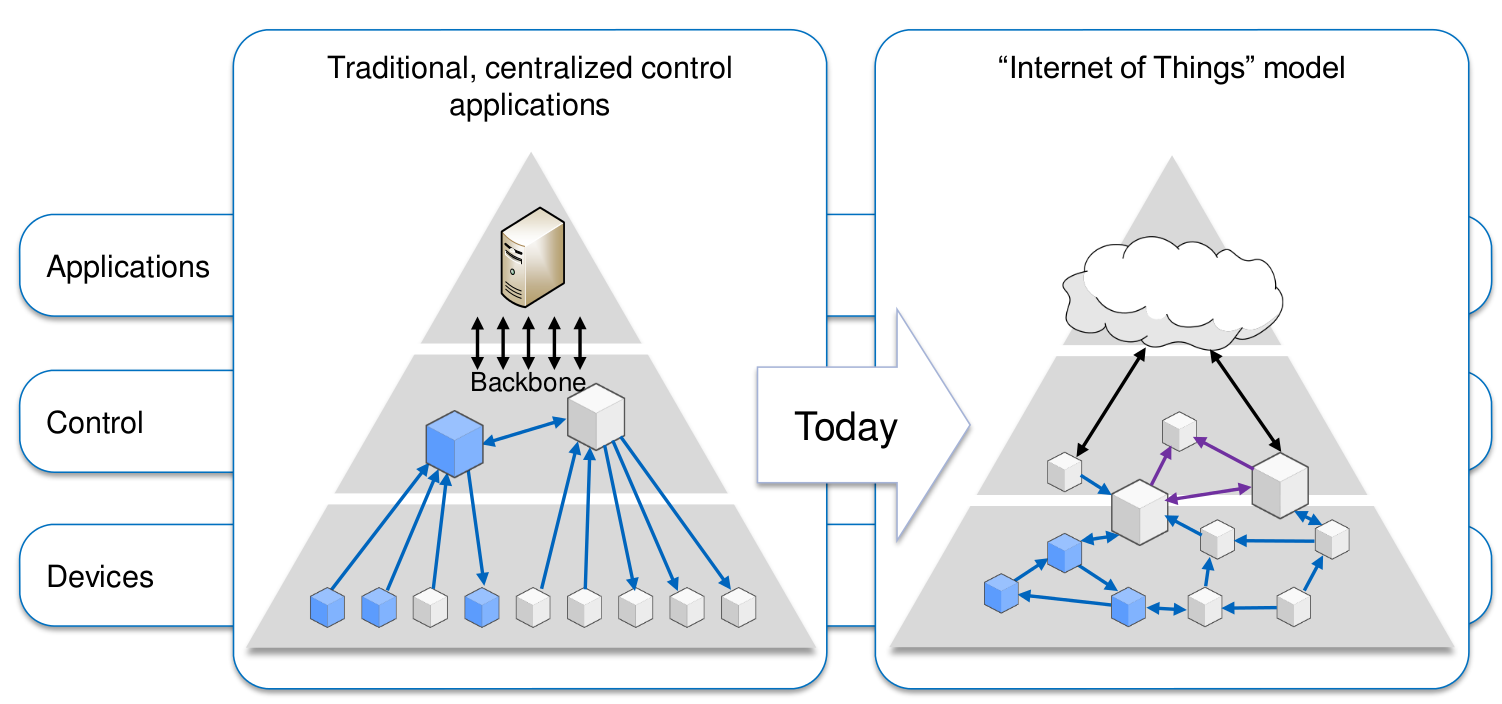
Although the main focus when talking about digital transformation is on people and use of emerging digital technologies such AI, Big Data, IoT, AR/VR, etc. It is important to understand that there is also a fundamental structural shift going on from a hierarchical systems approach to a distributed and collaborative human centered approach. The traditional approach to manufacturing systems design based on ISA-88 and ISA-95 hierarchical architectures which stem from a functional decomposition of the activities required for a manufacturing operation and process. These have served us well but in the future manufacturing operations landscape we will have a dynamic landscape of interconnected and collaborative edge or IIoT devices. They will not be top-down, command and control type architectures, which also put a question to the applicability of the current ISA standards to new digital manufacturing world!

In a Smart Factory the manufacturing system architecture will be more distributed yet not completely "flat". Digital technology takes a human centered approach that augments and support activities on the shop floor. The resulting architecture will be something that is called Heterarchy which in simple words mean a dynamic hierarchy. It is a networked structure that moves and changes with what is going on the production floor. Sounds real theoretical but in fact it is not, it is the same type of structure that we humans operate in every day. A system of independent components that work collaboratively toward a common goal or task. The figure below shows this in a simple graphic, notice the network of collaborative components in the "Internet of Things" model.

Image result for industrial internet of things model traditional
(from: The "Internet of Things" for industrial applications, Technical University of Munchen

So why is it called "Fog", they analogy comes from low clouds that make fog, i.e. bringing the Cloud closer to the edge you get fog - get it? So in the future IIoT and edge devices will not operate completely independently. They will collaborate and form local interconnected networks while using the Cloud as a form of supervisory level and a place to get a perspective on overall manufacturing states, long term predictions, and tasks that require more computing power. These dynamic networks in the "Fog" provides storage and applications that are distributed efficiently between the edge data source and the Cloud. Manufacturing data and information will be stored not only in the cloud but on the IIoT and edge devices in this "Fog". This is very important because in the new digital factory productivity gains will happen by making more intelligent decisions, and these decision will happen at the edge, i.e. on the production floor and not in the Cloud. Data in the Fog can be more accessible, more granular more real-time. Technologies will also allow use of this data, distributed as it may be, without needing to move it or transform it. Probably in the same way that we can visualize data that's in the Cloud today. 

Like I explained in the post about taking manufacturing back to the future the value is in the adaptability of the manufacturing operation that the Fog paradigm supports. Since the process behavior is dynamic and ever changing the only way to get consistent performance is by having adaptive control. Not only can adaptive control manage the ever-changing nature of the process’  internal and external factors, but it can also continuously learn, improve and thereby consistently increase performance and quality.

So this "Fog" concept seems scary and uncomfortable - and fog is in fact wet, cold and uncomfortable. Honestly, i am not that fond of the term either but I think its going to stick for a while. Maybe Holonic is a better term - dynamic and collaborative manufacturing systems and automation networks?

Sunday, March 11, 2018

My head is in the Cloud

I have spent the last 2 months coming up to speed with SaaS, The Cloud, Big Data and advanced analytics. Wow, I am amazed at how far technology has come. In the last 7 years it seems I have moved further and further away from software technology with my increasing operational responsibilities. I did my best to follow the general trends and progress but really never in enough depth. I knew there was something “big” happening but kept thinking “I know what is going on…”, “I should have a general understanding…”. When I stopped to really understand how far some of these technologies, we group under the “Industry 4.0” umbrella, have come I found it quite astounding!

The power of artificial intelligence (AI) and machine learning (ML) algorithms that are able find patterns we never knew existed in vast amounts and use this information to predict future behavior is amazing. Stories such as the one where Target (the retail store) was able to identify a girl as pregnant before her dad knew, stand as proof. I have also found the ease at which data can send data to the Cloud is just hard to understand. We have been fighting the connectivity and data contextualization problem for such a long time that its hard to believe it can be done any other way. If we take a breather, step out of the ditch and take a look around then we can quickly realize - we don’t need to do this anymore! Data can be collected by software agents running on everything from a server to a sensor and configured through a digital twin. There is no need to format, convert, transform or contextualize the collected data. In fact the AI and ML algorithms work best if we keep it unstructured and the smaller the data sets the better.

This is all very exciting and the more I think about how we can use these technologies the more more encouraged I am that we can achieve true manufacturing intelligence. The ability to have a real time picture of everything that is going on in our manufacturing plant is simple and achievable. On top of that we can discover relationships between processes and artifacts that we never imagined existed, and use these to improve, to better operate, and maybe stop the great firefight that is operating a plant. We can transform the daily operational meetings to something akin of a weather forecast - wouldn’t that be something to watch?