Analytics header

Showing posts with label Cloud. Show all posts

Sunday, August 18, 2024

About Accountants and Production Managers: ERP vs. MES

This is a rewrite of a whitepaper that I published in 2004 based on a long and frustrating MES selection process where the "can I use my ERP as MES" misunderstanding went rampant. I find that the discussion is still very relevant today and the topic gets even more confusing with some of the emerging digital technologies in this space. So this is an attempt to bring more clarity...

About ERP and MES

With today’s increasingly accelerating manufacturing technology innovation, digital transformation is critical for staying competitive. Among the key systems that have traditionally driven manufacturing operations are Manufacturing Execution Systems (MES) and Enterprise Resource Planning (ERP) systems. The myriad of opinions and discussion on these concept in the context of digital transformation and therefore understanding the differences between these two systems is crucial. In addition, as digital technologies continue to advance, the lines between MES and ERP are increasingly blurring, especially with the advent of No-Code democratization and Frontline Operations Platforms. I have found that and effective ways to conceptualize this is through the analogy of a production manager and a company accountant.


The Accountant: ERP’s Role in Manufacturing

In the last decade ERP systems have seen massive proliferation into many businesses, including manufacturing businesses. These businesses have invested heavily in ERP systems and today struggle to realize payback from these investments. In the case of manufacturing businesses, realizing ROI is logically focused on the production floor, an area in which ERPs are traditionally considered weak.

As the ERP market becomes increasingly saturated, vendors are looking for ways to increase revenue and expand their footprint. ERP vendors have turned their attention to shop floor management and manufacturing execution systems (MES). By adding MES functionality, they can increase license revenue. 

Consider the role of an accountant in a manufacturing company. The accountant manages financial records, oversees budgets, handles payroll, and ensures that all financial transactions comply with regulations. Their work involves high-level data analysis, financial forecasting, and strategic decision-making that influences the entire organization. This is akin to the role of an ERP system.

At their core, ERP systems are advanced accounting information management systems, they are enterprise-wide management tools designed to integrate various functions across a business. In manufacturing, ERP systems handle tasks such as procurement, inventory management, finance, human resources, and supply chain operations. They provide planning tools like Material Requirements Planning (MRP) and Manufacturing Resource Planning (MRP II), which help companies predict future resource needs based on historical data and forecasts.

However, despite their comprehensive nature, ERP systems are not designed to manage the real-time, dynamic environment of the production floor. They excel at providing a broad, strategic view but lack the granular control needed to manage the intricacies of manufacturing processes. Just as an accountant isn’t equipped to manage the day-to-day operations on the production floor, an ERP system isn’t designed to handle the real-time demands of production management.

The Production Manager: MES’s Role on the Shop Floor

MESs have evolved to address the inherently complex production management functions. An MES is a specialized system focused on the shop floor, where it manages real-time production activities. It coordinates equipment, workers, materials, and processes to ensure that production is carried out according to plan. Unlike ERP systems, MES operates in real-time, responding instantly to changes and ensuring that production goals are met. It tracks production data minute by minute, making it possible to identify and correct issues as they arise.

Imagine the role of a production manager. This person is in the thick of things, ensuring that production runs smoothly and efficiently. They manage workers, monitor machines, and make real-time decisions to keep everything on track. The production manager is intimately familiar with the production process, knows when to adjust schedules, and reacts quickly to any disruptions. This role exemplifies what an MES does in a manufacturing environment.

While ERP provides a high-level overview of production schedules and resources, MES is concerned with execution ensuring that production is executed as planned. MES is deeply integrated with the physical aspects of manufacturing, enabling it to manage the nuances of the production process that ERP systems cannot.

Differences Between MES and ERP


Aspect

ERP 

(Enterprise Resource Planning)

MES 

(Manufacturing Execution System)

Scope and Focus

Covers a wide range of business functions across the entire enterprise. Designed for strategic planning and resource management across departments.

Specifically focused on the production floor, with deeper engagement in executing production processes, equipment monitoring, and labor management.


Data and Time Frame

Deals with high-level, aggregated data, often historical or forecast-based and financially biased. Works on a broader timeframe for long-term planning and decision-making.


Operates in real-time, handling detailed, granular data from the shop floor, responding immediately to production needs.

Integration and Flexibility

Integrates various business functions but often lacks the flexibility needed for real-time adjustments on the production floor.

Highly flexible and adaptable to the dynamic environment of manufacturing. Integrates with machinery, sensors, and other shop floor systems.

Decision-Making

Supports strategic, long-term decision-making at the corporate level, focusing on overall financial business performance and resource allocation.

Highly flexible and adaptable to the dynamic environment of manufacturing. Integrates with machinery, sensors, and other shop floor systems.


Blurring the Lines: How Digital Technologies Are Redefining MES and ERP


As digital transformation continues to reshape manufacturing, the era of traditional monolithic MES may be coming to an end. New technologies and platforms are presenting a different way to solve the shop floor management coordination challenge. Based on the foundations of MES these new solution incorporate advanced digital technologies such as No-Code, IIoT (Industrial Internet of Things), machine learning, AI-driven analytics, Generative AI and enhanced user interfaces. They offer a more holistic view of manufacturing operations, providing real-time insights that empower workers on the shop floor to make data-driven decisions.

Unlike traditional monolithic MES, which focused solely on production execution, the new breed of technologies leading with the Frontline Operations Platforms encompass a broader range of activities, including quality control, maintenance, lab operations, inventory management, and workforce training. This transformation is a direct response to the growing need for systems that not only manage production but also integrate seamlessly with other digital tools and platforms to enhance overall operational efficiency. It also aligns with the broader digital paradigm, where the goal is not just to automate existing processes but to create a more connected, intelligent, and responsive manufacturing environment. The integration capabilities of Frontline Operations Platforms enable a seamless flow of information between the shop floor and the enterprise level, blurring the traditional lines between MES and ERP.

Several key trends are driving this convergence:

1. IIoT and Real-Time Data Integration:

The proliferation of IIoT devices on the shop floor allows for the real-time collection and analysis of data. This data can be fed into both MES and ERP systems, enabling more informed decision-making across all levels of the organization. For instance, real-time production data captured by IIoT sensors can be used by the ERP system to adjust supply chain logistics or by the MES to optimize production schedules on the fly.

2. Advanced Analytics and AI:

Machine learning and AI are increasingly being used to analyze the vast amounts of data generated by manufacturing processes. These technologies enable predictive maintenance, demand forecasting, and process optimization, functions that traditionally belonged to either MES or ERP. The use of advanced analytics allows these systems to overlap, as both can now contribute to strategic and operational decision-making.

3. Human Centric Platforms:

The new no-code platforms take a human centric approach that break down the traditional process centric solution. They allow to build solution that can be used across manufacturing modalities and also allow to combine MES and ERP functionalities blurring the lines between the two. The new solutions provide a democratized platform for managing all operational process. Workers on the shop floor, managers, and executives can all access the same platform, though with different levels of detail and control, depending on their role.

4. Cloud Computing and Edge Computing:

The shift towards cloud-based solutions and edge computing is enabling greater integration and scalability of MES and ERP systems. Cloud computing allows for centralized data management, making it easier to integrate MES and ERP data. Edge computing, on the other hand, brings computational power closer to the production site, enabling real-time data processing and decision-making that benefits both MES and ERP functions.

5. Interoperability and Open Standards:

Increasingly, manufacturers are adopting interoperable systems that can communicate with each other through open standards. This trend is making it easier to integrate MES and ERP systems, allowing for a more seamless exchange of data and better collaboration between different departments.

The Future: A Converged System for Manufacturing Excellence

The convergence of MES and ERP functionalities into more integrated platforms represents the future of manufacturing. As these systems continue to evolve, they will offer manufacturers the ability to manage both high-level strategic planning and detailed operational execution through a single, cohesive platform. This convergence will enable a more agile and responsive manufacturing process, better equipped to meet the demands of the modern market. The systems are working together more closely than ever, driven by advancements in digital technology that empower manufacturers to achieve new levels of efficiency, flexibility, and innovation.

In Summary...

In the rapidly changing landscape of manufacturing, understanding the distinct yet increasingly interconnected roles of ERP and MES systems is crucial. As digital technologies continue to advance, these systems are evolving and converging, offering manufacturers a powerful toolset for driving operational excellence. The transformation of MES into Frontline Operations Platforms exemplifies this convergence, blurring the lines between strategic planning and operational execution. By embracing these integrated platforms, manufacturers can unlock new opportunities for efficiency, agility, and competitiveness, setting the stage for a new era of manufacturing excellence in the digital age.

Yet, it is naive and risky to assume that one of these systems can be extended to effectively do the other’s job. Similarly, one would not assign an accountant to be a production manager, or vice versa. Each might be an expert in his own field, yet it takes a completely different set of skills, expertise and knowledge to effectively tackle each task.


Monday, June 26, 2023

To Data Model or not to Data Model

The ongoing debate about where and how MES fits in new era of digital technologies is raging. Its not surprising and in fact to be expected in any kind of change, basically the old guard vs the new guard. Of course you have to believe that the 4th industrial revolution is really a paradigm change. Something that I clearly align with and have some background to do so since I have been studying this phenomena since the 1990s.

As in other paradigm shifts there will always be a bit of the old that is part of the new. Steam power has not completely disappeared, it still relevant in specialized application but it is not the main source of energy powering industrial operations. This leads us to ISA-95 that I believe is a relic of the current "industry 3.0" era and not directly relevant in the new digital paradigm. (note I purposefully am trying to minimize the use of "Industry 4.0" since it starting to get a negative connotation with all the hype going on). But, that being said there are elements of ISA-95 and other best practices that may be relevant in the new paradigm, ie the old in the new?

If we let history be our teacher we can probably come up with some prediction and that is where the data model topic is interesting. ISA-95 includes a data model and all the established MOM solution include a data model that based on the available technologies at the time that seemed appropriate. The question is then; is the quest to achieve the nirvana of one standard monolithic data model for all manufacturing achievable and is it still relevant with the new digital technologies? The answer I think is clearly no and no, as far as I know there are very few, if any, examples of an organization achieving a real working standard data repository for all its operation and its not because of lack of trying.

The bottom line here is that striving for a single standard data model in a monolithic repository is a fools errand, regardless of if we try to implement it with modern digital technologies. That being said a common, shared and interpretable view of manufacturing operations is still needed and critical. In fact it's at the core of Industry 4.0, in that its the data and information that gives us the Visibility, Transparency, Predictive Capacity and Adaptability. This holistic view into the manufacturing operations is also at the core of the CIM concept from the 80s that advocated a common "shared knowledge" that all operational activities in plant uses in order to streamline to manufacturing of products. That means that both paradigms are aligned around the same challenge that to improve manufacturing operations we need to all have a common understanding and view into the operation!   

The CIM Enterprise Wheel (c)1993, SME.

The difference is how we achieve this common and shared view (information and knowledge). In the old paradigm it was the notion of a strict and rigidly structured data model, in the new paradigm we have relaxed these requirements to allow for analysis from both structured and unstructured data. I can hear the skeptics already; how can you gain any insights with different solution each having their own data structures? A few things to consider here: We do need context and this context should be defined at the source. We need to simplify data structures and get away from multiple levels of abstractions needed to run monolithic process driven solution.  Adhere to some simple shared guidelines using a consistent data dictionary that allows for flexibility within your organization. (I know this sounds overly simplistic and see part II of this blog post). With these principles we can adopt many of the modern digital tools to curate views into our data, on demand with the flexibility needed for common and personalized views and insights including of course AI.     

Let's take at an example where different solutions all represent some data about a lot of materials and its product code. The material can be referenced as Lot, Batch, Units, Pack, Kit, etc and the product code can be references as SKU, Item ID, Product, Material Number, etc. We of course immediately recognize these different names as similar because we understand how they are used. In the old paradigm we had to enforce strict rules in structure and semantics for software solution in order to visualize and analyze this data. That is however changing with new digital technologies and modern analytics platforms.  

It is also where AI can help, you see simply put AI is good at finding patterns. Its not that AI understands what the meaning of Item and Material Number is. It simply is looking for similarities in the relationship to other data structure and how its used to see that Item and Material Number really are very similar. With enough data volume and variety this can be easily detectable. Notice I said volume and variety this is where Cloud based system are important. Using isolated traditional monolithic system data sources will never get you to this point, even if they are lift and shifted to the cloud. You need a modern cloud native operational platforms that provides easy access to the their data that can be amassed and used to identifying these patterns.

I know there are a number of concepts discussed here and there may be some lack of depth in the discussion. I promised a follow up on this post with some more detail. But assuming this is true, just think about it. It means we can relax the strict data type and structure requirements and allow citizen developers to extend template data structures to create solution to solve operational problems and know that we can still gain valuable insights about operations, and again the more data we have to more insight we have. The conclusion here is: prioritize data volume and variety and not monolithic structures.

Sunday, June 11, 2023

4 Questions As a Guide Towards True Digital Transformation

Most people that have heard me talk about digital transformation are probably sick of hearing me talk about the "order of magnitude" productivity gain that is promised by the ongoing digital industrial revolution. But here again it is a key principle that can be used to understand transformation and navigate through the existing maze of confusion of what is and is not digital technology. Simply put digital technology is a technology that can directly impact industrial or manufacturing operations to bring about an order of magnitude productivity increase. 

I have compiled 4 critical elements that can help you sort through the maze of different technologies that are touted as digital, Industry 4.0 or Smart Manufacturing technologies based on this principle. These 4 elements can be framed as question that guide evaluation and selection of technologies:

Is it adopted and implemented in a "Bottom Up" manner?

Adoption and implementation are performed in an agile method, starting small in an iterative manner and building on outcome of each iteration. Agile approaches are an inherent part of the digital transformation and advocate a way to learn faster by short and rapid test-fail-learn cycles. The overall manufacturing systems solution is built from the bottom up in an iterative manner. 

This is in stark contrast to the traditional system approaches, including MES, where top down hierarchical processes are used to provide a solution that fits within specific constraints that is hard to change. There should be no "gap assessments", the technology is adapted to the process in contrast to fitting the process to the solution. It also removes the difficulties associated with adhering to complicated standards and systems. It frees engineers to focus on building solutions rapidly that fit the process and increases the rate of implementation by an order of magnitude (here I go again...). There are some interesting implications to this approach one of which is that Industry 3.0 standards such as ISA-95 becomes less relevant in this context.

Does it inherently support and enable Continuous Improvement?

Lean principles are still the most effective way to achieve productivity increases in an industrial operation and therefore the technology should be a tool to implement these operational improvements. The adoption of the technology should be done in a methodical PDCA or DMAIC cycle with each improvement supporting the next. Changes and modifications to a solution are easy and support iterative and constant improvement. The technology solutions are targeted at improvement areas with clear and quantified goals.   

It should be no surprise that regardless of the paradigm shift that is going on Lean and the principles of TPS are still real and valid. There is a close connection between the continuous improvement process and agile (bottom up) development approach of using the technology/solution. Th technology should be a Lean tool that allows engineers to rapidly iterate thru solutions to problem building digital content to an effective solution. 

Does it offer a Democratized approach and how does it enable "Citizen Developers"?

Users and implementors of the technology do not need to have unique and specific skills that are common for software, IT or automation engineers. Engineers and SMEs can rapidly adopt the technology to develop solution for the operations. The technology is so easy to use and learn that it is effectively accessible to most people with a basic level of technical aptitude. This allows the people that are closest to the process to craft solutions that are focused on solving a problem or provide an improvement. The technology should be adopted by people from within the operation rather than implemented by external parties.

Democratization and the citizen developer is an important aspect of the digital transformation. With modern digital technology we all can become builders of digital content. We already do this when using office tools such as Word and Excel and now we can even easily program our IoT door to open automatically when we get within range so we don’t have to take our key out. This is a big change compared to the high level of skills and expertise needed to build even simple automation tasks in traditional systems. No-Code/Low-Code is a key enabler of Democratization, it allows people with no programming or IT skills to build content that automates manufacturing processes in a simple and intuitive way. 

I find that for bigger organizations citizen development may be alarming, i.e. they feel it is akin to "arming the rebels". However there is no way around it, the benefits far outweigh the risks in this case and democratization of technology is key element of the new digital age. At the same time most of the new platform technologies provide accessible and transparent control and management of content being created and consumed. 

Is the technology able to provide Human Centric solutions?

The use of the technology should result in solution that serve humans or specifically frontline operators. It has to be intuitive, simple, easy to understand and easy to use. It has to serve the frontline operator by making him more productive, the operator is the key to the productivity gains promised by digital technologies in I4.0  

Modern digital technologies and tools are built on the principle of supporting human activity, that is what makes them so effective and so widely adopted. People are the key to unlocking productivity gains from digital technologies, that therefore have to focus on supporting human activity. The premise is that in order to increase productivity technology needs to support the human operator. In the new digital age manufacturing needs to enable the connected worker whose tasks are monitored and supported by a larger network of digital tools. In addition the technology should be used to capture additional digital data streams such as instrumentation of the human activity, the data that human operators collect, input they can provide about the process, and more. 

In conclusion, if a technology is not able to impact your operations in this significant way then its not digital technology - simply drop it from the list. Let's take a simple example: SaaS MES that is purportedly in the cloud and requires experts with specific skills set to configure and use with a 6+ months implementation time frame. This is not and example of digital technology. You should be seeing quantifiable productivity increase results within weeks of adopting any technology.  Another example is if the technology implementation requires a waterfall/phased method that requires design of the substantial parts of the solution upfront then it is not a digital technology!  

You can watch me talk about these topics on the Manufacturing IT Podcast with Daniel Langley.

Maybe this will also nudge the skeptics out there since speed, effort and real world double and triple productivity gains are becoming real and undeniable. Charlie Chaplin once said "if you look down, you will not see the rainbow".

Tuesday, February 5, 2019

The return of custom built manufacturing software

Is it really happening? Are the new digital technologies making it attractive and maybe even necessary to develop custom manufacturing systems solutions? For years we have advocated that companies focus on their core business competencies and leave the software development to expert best in class software companies. There are many horror stories of companies that are stuck supporting custom built software that is running their critical operations, why build and spend millions maintaining in house developed systems?

With the emergence of new digital technologies I see companies once again opting to develop custom software to solve their manufacturing systems needs. Is it because it is the 4th industrial "revolution", or is this truly something to consider, does it bring value and if so how? I believe there are a number of forces at play that are causing this to happen.
  • Emerging digital technologies specifically cloud based SaaS solutions provide user friendly ways to solve some specific problems like analytics and integration with very quick ramp-up times. I.e. you don't need a lot software development skills.
  • There is a real business need to get the promised productivity gains from these digital technologies. In other words organization have allocated money and people to get things moving in their digital transformation
  • The new generation of workforce comes from the digital age (i.e. digital natives) and are used to in simple words, just download an app for that. They are confronted with what they see as antiquated software systems that are not really user friendly and their reaction is to find another app.
  • The new digital technologies in general are human centered - they are developed to solve (and support) what we as people do, where as traditional business software is developed to automate a process.
  • The current solution landscape of available digital technologies, in what we know of as the manufacturing system domain, is very fragmented and somewhat immature. Yes there are pieces of it specifically in the Cloud part that are further along but in general no.   
So, is this a case of history repeating itself? Will we see a resurgence of home grown solution that we will in a few years pay dearly to replace with available software form industry suppliers? I am not going to try and be a futurist but I think we can apply some logic to what the future can bring.  So in general, yes I think so - although it will be different (what an ambiguous answer). There will be some level of custom software being built but at the same time there are some forces at play that are different from what we have seen in the past, and these will make a big difference.

The rate of software development and how fast it is maturing is much greater that it was in the past, and the new technological landscape will consist of a network (or mashups) of different systems.
We will not have specific monolithic systems for each department or business function. The future digital factory will be supported by a network of Cloud and Fog (or Edge Computing) software components that will have been put together from the bottom up. The future manufacturing systems will develop and mature over time thru emergence rather than a top-down design and development process. Think about that - if this is true so much of our current approaches will not work (GAMP, ISA-95/88, etc.)!

So much for my prediction of the future, PS no AI used here 😉.

Saturday, January 26, 2019

What is the Fog, and why does it matter?

Its not Karl the fog, but the industrial Fog! In news recently is the joining forces of the Industrial Internet Consortium® (IIC) and the OpenFog Consortium® (OpenFog). While manufacturers are still grappling with new technologies related to the new digital world (i.e Industry 4.0 and Smart Manufacturing) here comes another concept out of left field. So I guess the question is what is it and why does it matter right now, how will this bring me to the order of magnitude productivity increase.

Nobody said revolutions and transformation are easy, they require moving forward into the unknown - something us engineering have a really hard time with. Good news, there is no need to stress or move right now, but it is important to understand what it is. Especially when balancing existing needs served with exiting technologies while at the same time moving into the new paradigm. This is a common topic that I have been talking to many of you out in industry and hear the same frustrations: "We have to help the manufacturing operations today with technologies that we work while trying to figure out which digital technologies are ready for  prime tome now and which will take some more time to mature". Not sure how many people read this blog, but I wanted to try and give you my perspective.

Although the main focus when talking about digital transformation is on people and use of emerging digital technologies such AI, Big Data, IoT, AR/VR, etc. It is important to understand that there is also a fundamental structural shift going on from a hierarchical systems approach to a distributed and collaborative human centered approach. The traditional approach to manufacturing systems design based on ISA-88 and ISA-95 hierarchical architectures which stem from a functional decomposition of the activities required for a manufacturing operation and process. These have served us well but in the future manufacturing operations landscape we will have a dynamic landscape of interconnected and collaborative edge or IIoT devices. They will not be top-down, command and control type architectures, which also put a question to the applicability of the current ISA standards to new digital manufacturing world!

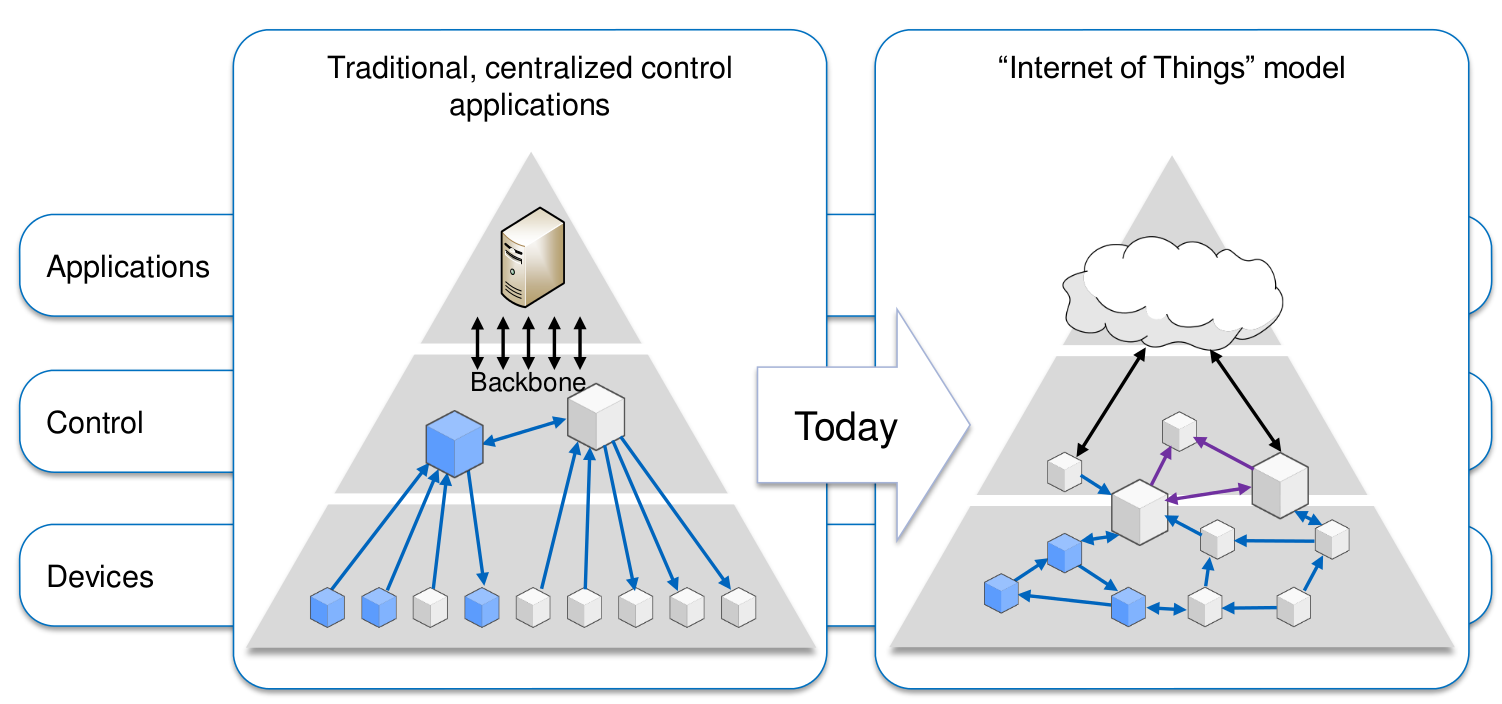
In a Smart Factory the manufacturing system architecture will be more distributed yet not completely "flat". Digital technology takes a human centered approach that augments and support activities on the shop floor. The resulting architecture will be something that is called Heterarchy which in simple words mean a dynamic hierarchy. It is a networked structure that moves and changes with what is going on the production floor. Sounds real theoretical but in fact it is not, it is the same type of structure that we humans operate in every day. A system of independent components that work collaboratively toward a common goal or task. The figure below shows this in a simple graphic, notice the network of collaborative components in the "Internet of Things" model.

Image result for industrial internet of things model traditional
(from: The "Internet of Things" for industrial applications, Technical University of Munchen

So why is it called "Fog", they analogy comes from low clouds that make fog, i.e. bringing the Cloud closer to the edge you get fog - get it? So in the future IIoT and edge devices will not operate completely independently. They will collaborate and form local interconnected networks while using the Cloud as a form of supervisory level and a place to get a perspective on overall manufacturing states, long term predictions, and tasks that require more computing power. These dynamic networks in the "Fog" provides storage and applications that are distributed efficiently between the edge data source and the Cloud. Manufacturing data and information will be stored not only in the cloud but on the IIoT and edge devices in this "Fog". This is very important because in the new digital factory productivity gains will happen by making more intelligent decisions, and these decision will happen at the edge, i.e. on the production floor and not in the Cloud. Data in the Fog can be more accessible, more granular more real-time. Technologies will also allow use of this data, distributed as it may be, without needing to move it or transform it. Probably in the same way that we can visualize data that's in the Cloud today. 

Like I explained in the post about taking manufacturing back to the future the value is in the adaptability of the manufacturing operation that the Fog paradigm supports. Since the process behavior is dynamic and ever changing the only way to get consistent performance is by having adaptive control. Not only can adaptive control manage the ever-changing nature of the process’  internal and external factors, but it can also continuously learn, improve and thereby consistently increase performance and quality.

So this "Fog" concept seems scary and uncomfortable - and fog is in fact wet, cold and uncomfortable. Honestly, i am not that fond of the term either but I think its going to stick for a while. Maybe Holonic is a better term - dynamic and collaborative manufacturing systems and automation networks?

Sunday, March 11, 2018

My head is in the Cloud

I have spent the last 2 months coming up to speed with SaaS, The Cloud, Big Data and advanced analytics. Wow, I am amazed at how far technology has come. In the last 7 years it seems I have moved further and further away from software technology with my increasing operational responsibilities. I did my best to follow the general trends and progress but really never in enough depth. I knew there was something “big” happening but kept thinking “I know what is going on…”, “I should have a general understanding…”. When I stopped to really understand how far some of these technologies, we group under the “Industry 4.0” umbrella, have come I found it quite astounding!

The power of artificial intelligence (AI) and machine learning (ML) algorithms that are able find patterns we never knew existed in vast amounts and use this information to predict future behavior is amazing. Stories such as the one where Target (the retail store) was able to identify a girl as pregnant before her dad knew, stand as proof. I have also found the ease at which data can send data to the Cloud is just hard to understand. We have been fighting the connectivity and data contextualization problem for such a long time that its hard to believe it can be done any other way. If we take a breather, step out of the ditch and take a look around then we can quickly realize - we don’t need to do this anymore! Data can be collected by software agents running on everything from a server to a sensor and configured through a digital twin. There is no need to format, convert, transform or contextualize the collected data. In fact the AI and ML algorithms work best if we keep it unstructured and the smaller the data sets the better.

This is all very exciting and the more I think about how we can use these technologies the more more encouraged I am that we can achieve true manufacturing intelligence. The ability to have a real time picture of everything that is going on in our manufacturing plant is simple and achievable. On top of that we can discover relationships between processes and artifacts that we never imagined existed, and use these to improve, to better operate, and maybe stop the great firefight that is operating a plant. We can transform the daily operational meetings to something akin of a weather forecast - wouldn’t that be something to watch?