Analytics header

Showing posts with label MES. Show all posts

Sunday, December 14, 2025

Agentic AI in Action: What I Learned Experimenting with Operational and Builder Agents

Over the last several months, I’ve been deepening my exploration of Agentic AI within Tulip, applying the concepts I laid out in my Agentic Framework and testing them in real operational scenarios. What started as curiosity has quickly become something else entirely: a recognition that we are opening a fundamentally new chapter in how manufacturing systems are built, operated, and scaled.

As I’ve experimented with both operational agents—those that support frontline teams in real time—and builder agents—those that help design, generate, and improve digital solutions—I am realizing how deep and wide the impact is going to be. The more I explore, the more use cases reveal themselves, and the more explosive the potential becomes. Its much more than I initially thought, and I have been thinking in terms of multi-agent systems for manufacturing since the 90's! Agentic AI (multi-agent systems powered by generative AI) are a much bigger step change than I would have imagined to how we think about creating and running manufacturing solutions.

Let's start with a brief recap. Operational agents extend the capability of the production system realizing digital twin capabilities in ways that introduce reasoning, interpretation, and contextual understanding directly into the work being done on the floor. Builder agents open the door to a multithreaded, parallel engineering process that fundamentally changes the speed and depth at which solutions can be created. It feels less like a “copilot” assisting a developer and more like a coordinated team of SMEs designing solutions - Augmented Lean at hyperspeed!

This combination—augmenting frontline execution while accelerating the design and iteration of digital systems—points to a future where humans orchestrate agent ecosystems rather than manually building every piece of a solution themselves. This brings me to the motivation for writing this post that became clear to me in a recent customer conversation about DCS integration in support of a digital solution for pharmaceutical manufacturing of clinical drugs.

Reimagining Composable Integration with DCS and ISA-88 Through Agentic AI

The question I was asked recently wasn’t the classic “How do you integrate an MES with a DCS?”—that problem has been addressed in many different ways in the traditional architectures. The real question was far more interesting: How do you integrate a Composable MES built on a Frontline Operations Platform with a DCS or other ISA-88 based batch system?


In a traditional MES world this integration immediately triggers a familiar debate about how to partition the recipe across systems, define boundaries of responsibility, and reconcile master data, recipe models and equipment hierarchies. And that debate is almost always constrained—if not outright dominated—by the rigidity of monolithic MES platforms. The architecture drives the discussion more than the operational needs do.

But in a composable environment, the constraints that shaped those historical debates simply don’t apply. Let's look at what happens when you apply a composable, agentic model.

1. Composable Apps Remove the Traditional Constraints

In a composable architecture, apps are not bound to a predetermined master data model or recipe structure. This means that there is no need for recipe model partitioning, no need to replicate equipment hierarchies, no predefined S88 recipe model to map into. 


This flexibility removes the most painful barrier in traditional MES ↔ DCS integration: the structural reconciliation of recipes and equipment models. The DCS can continue using its ISA-88 representations. Tulip apps can represent the process in the most intuitive and useful way. And the integration simply becomes the mapping of meaning and intent between the two worlds. You design the representation of the process that makes sense for your operation—not the one dictated by the systems.

Composable solutions also shift the perspective entirely by taking a human-centric, activity-based approach organized around the physical reality of the shop floor. I fully recognize that, in the traditional monolithic MES world, standard models like ISA-88 were considered essential—they provided structure, discipline, and a shared language for process-centric systems. But composability represents a fundamentally new paradigm

To democratize operational systems and bring them closer to frontline work, we must prioritize operator-first design rather than forcing every SME to become a master of S88 modeling. ISA-88 remains invaluable for process control, but the surrounding operational systems must be simplified and democratized so they can work hand in hand with the distributed nature of modern manufacturing. Composable platforms do exactly that: they allow process engineers, chemical engineers, and frontline teams to collaborate without being constrained by rigid, expert-only models.

This alone would dramatically simplify integration. But the real breakthrough comes with agents.

2. Builder Agents Enable Multithreaded, Generative Solutioning

Builder agents transform integration work from a linear, manual design activity into a parallel, iterative, and generative process. They don’t just help you “build faster”—they fundamentally change how solutions are conceived and engineered.

I experimented with builder agents that can ingest a full ISA-88 recipe structure and conduct deep introspection on it: understanding the procedural models, identifying phase logic, parsing parameter definitions, and extracting the relationships between equipment, units, and operations. It then suggested mappings, app contexts, and design patterns—not only based on expert interpretation of the ISA-88 standard, but also from what they’ve learned across existing apps, historical integrations, real-world performance of similar solutions and critically expert knowledge of composable design principles. In other words, these agent combines domain expertise with empirical insight, offering design options that reflect both best practices and operational realities.

This alone already feels like having a team of process engineers and MES architects working in hyperspeed. But the true power emerges when operational agents begin contributing dynamic intelligence into that design loop.


Operational agents provide real-time feedback about process variability, material availability, logistics implications, quality status, or unexpected delays. They can accommodate non-optimal or evolving recipes by dynamically dispatching materials, reallocating resources, or bringing the right expertise into the process at the right time. This dramatically increases operational resilience and reduces risk—because the system adapts rather than stalls when confronted with real-world complexity.

And then there’s compliance...

Specialized builder agents trained on GxP principles can support on-the-fly risk assessments, propose mitigation strategies, and generate validation documentation as part of the design cycle. Operational validation agents can take this further, enabling true continuous validation—monitoring execution conditions, evaluating deviations against risk models, and providing traceable explanations for decisions. Compliance becomes embedded, in fact native, in the system rather than layered on top.


When you step back and think about the implications, the potential is almost infinite. The combination of builder and operational agents elevates agility and compliance to levels we’ve never imagined in traditional MES architectures and design approaches. It enables systems that are not only faster to build, but continuously improving, self-aware, and aligned with both operational needs and regulatory expectations.

This is the beginning of a new era in how manufacturing solutions are designed, executed, and validated. It feels like a generative design process running at hyperspeed. Not a single assistant helping you code tasks faster — but a team of AI experts collaborating to create a complete solution.

And this unlocks something we have never had before in manufacturing software: the ability to rapidly iterate and explore multiple viable integration architectures before committing to one. This is enormously valuable in an ISA-88 context, where recipes, equipment logic, and operational variability rarely align perfectly.

Seeing the Explosion of Use Cases

If you let the builder and operational agents begin to work together, the number of possibilities just explodes - its the first step towards a Multi-Agent System (MAS). These agents don’t simply execute tasks—they learn, reason, and collaborate in ways that constantly reinforce and expand what’s possible. Suddenly, problems that used to take months of engineering effort can be tackled in days—or even hours.

Some of the notable and exciting use cases I’ve come across include:
  • Automatically mapping process logic into app structures.
  • Rapidly generating compliant workflows for regulated environments.
  • Exploring recipe variants and operational scenarios through simulation.
  • Using agents to assist in validation and documentation.
  • Dynamically interpreting and adapting recipes at runtime.
  • Applying cross‑system reasoning to catch inconsistencies early.
  • Coordinating multiple agents to design complete production solutions.
Each one opens a new door—where imagination, not technical limitation, becomes the real constraint.

What stands out to me most is the sheer power of these systems and what they make possible. Seeing a builder agent reason through an ISA-88 recipe, or an operational agent adapt to a real-time process disruption, feels less like traditional programming and more like working alongside a tireless, highly capable collaborator. My role has shifted from hands-on integration to guiding and steering intelligent agents—and that shift fundamentally changes how we think about manufacturing systems. The emerging dialogue between human expertise and machine reasoning opens up an entirely new design space, one where adaptability, resilience, and scale are no longer constrained by human bandwidth.

I’m also starting to document and share some of these experiences through AI‑generated videos, another capability I’m learning to use. They’ve turned out to be a surprisingly powerful way to show what agentic systems can do—and to help others visualize these new forms of collaboration on the shop floor. It’s a learning journey in itself, but it feels like the right extension of this exploration: using AI not only to build better systems but to communicate and learn in entirely new ways.

Seeing all of this unfold up close, it’s clear we’re not just evolving automation—we’re watching Holonic concepts come alive, the manifestation of the new digital manufacturing reality.

Crossing the Digital Divide: Human-Centric Manufacturing in a Multi-Agent World

When you step back and look at what emerges from the combination of builder agents and operational agents, it becomes clear that this is not just another productivity boost or architectural evolution. It is a convergence point — one that aligns remarkably well with how manufacturing operations have always been run by humans.

Manufacturing has never been a purely deterministic, rules-based environment. It is adaptive, situational, and deeply human. Engineers design intent. Operators respond to reality. Supervisors balance constraints. Quality professionals manage risk. For decades, our digital systems have struggled to reflect this reality, forcing people to adapt to rigid models and monolithic workflows rather than supporting the way work actually happens.


Multi-agent systems change that equation by enabling digital systems to finally reflect the way manufacturing actually operates—through parallel problem solving, continuous adaptation, and coordinated decision-making across people, processes, and technology.


Builder agents mirror how engineering teams work: exploring options in parallel, iterating designs, learning from past outcomes, and continuously refining solutions. Operational agents mirror how plants operate: responding to variability, adjusting to constraints, coordinating people and materials, and managing risk in real time. Together, they form a digital system that finally behaves the way manufacturing organizations behave — collaborative, contextual, and resilient.


This is profoundly human-centric, because it aligns digital systems with how manufacturing teams actually operate — dynamically, collaboratively, and contextually.


It also brings into sharp focus a theme I’ve been writing and speaking about since the late1990s. For decades, we have tried to digitize manufacturing by automating tasks, enforcing standard models, and embedding rigid logic into systems. That approach delivered value, but it also created the very constraints that now limit agility, scalability, and innovation.


What we are seeing now is the realization of a different paradigm — one where digital systems augment human reasoning instead of replacing it, where composability replaces monoliths, and where intelligence is distributed across agents rather than centralized in static applications. This is the paradigm shift I’ve been pointing to for years, and it is finally reaching a practical, scalable form.

The convergence of composable platforms, agentic AI, and multi-agent collaboration marks a true inflection point. We are no longer just modernizing legacy systems. We are crossing the digital divide — moving from systems that support transactions to systems that participate in operations.

The potential here is vast! Agility, resilience, productivity, and compliance are no longer trade-offs. They become reinforcing outcomes of a system designed around human workflows, continuously learning agents, and real-world context.

This is not the end state — it’s the beginning. But for the first time, the tools, platforms, and paradigms are aligned. And that alignment is what makes this moment different from other transformative eras that came before. And it will not stop - that is why we call it continuous transformation! 


Tuesday, August 26, 2025

Why Are We Still Talking About MES–ERP Integration?

Every few months, I still come across discussions about how to integrate MES and ERP. And every time, I find myself asking: why are we still talking about this?

It’s a bit like asking whether a boat floats. The answer is obvious—yes, it does. The real question is where is it going and why are we on it?

Integration Isn’t the Problem

Let’s be clear: integration between MES and ERP is not new, nor is it unsolved. For decades, manufacturers have been connecting these systems to exchange the information that keeps their operations running. I challenge you—have you ever heard of an MES system that couldn’t integrate to ERP?

The technology is there. APIs, middleware, standardized data models, cloud-native platforms—the tools have only gotten better. Integration is no longer the hard part.

As I wrote in an earlier post "About Accountants and Production", ERP and MES have always been about different things. ERP is designed for financial management (order-to-cash) - transactions, costs, compliance, reporting. MES is built for the shop floor—real-time visibility, control, and execution. Each system has its domain. Integration ensures they don’t talk past each other.

But the value doesn’t come from whether or not you can connect the two. It comes from what you do with that connection.

From Technical to Value-Driven

When integration conversations remain technical—what middleware to use, which API calls to expose—we miss the bigger picture.

The true conversation should be:

  • What processes, operations and decisions do we want to improve?
  • What outcomes are we aiming to achieve?
  • What value will the integration unlock for the business?
For example, integrating to have a streamlines and effective work order execution from ERP to MES is not valuable because the two systems are connected. It’s valuable because it eliminates manual re-entry, reduces errors, speeds up production scheduling, and ensures financial systems reflect operational reality in near real time.

Integration is the means. Value is the end.

Enter the Age of Digital and AI

We’re well into the era of digital, transformation is ongoing and constant, and AI in manufacturing is becoming a reality. Advanced analytics, machine learning, digital twins, and agentic AI are reshaping how operations are managed and humans work. Against that backdrop, spending time debating MES–ERP integration feels outdated.

The real opportunity is to ask: how do these systems, together, create the digital backbone that enables AI to bring operational insights that deliver business value?

ERP knows the plan. MES knows what actually happened. AI thrives when it can see both and spot patterns across them—optimizing schedules, predicting disruptions, and suggesting interventions. That’s the conversation worth having.

Time to Move On

So let’s put this to rest: MES and ERP can integrate. They do integrate. The technical questions have answers.

The real debate—the one that matters in the age of digital and AI—is about value. How do we design our digital architectures, processes, and cultures so that integration serves as the foundation for smarter, faster, and more agile manufacturing? Shift the focus from can we integrate? to what value will the integration deliver?

Sunday, August 18, 2024

About Accountants and Production Managers: ERP vs. MES

This is a rewrite of a whitepaper that I published in 2004 based on a long and frustrating MES selection process where the "can I use my ERP as MES" misunderstanding went rampant. I find that the discussion is still very relevant today and the topic gets even more confusing with some of the emerging digital technologies in this space. So this is an attempt to bring more clarity...

About ERP and MES

With today’s increasingly accelerating manufacturing technology innovation, digital transformation is critical for staying competitive. Among the key systems that have traditionally driven manufacturing operations are Manufacturing Execution Systems (MES) and Enterprise Resource Planning (ERP) systems. The myriad of opinions and discussion on these concept in the context of digital transformation and therefore understanding the differences between these two systems is crucial. In addition, as digital technologies continue to advance, the lines between MES and ERP are increasingly blurring, especially with the advent of No-Code democratization and Frontline Operations Platforms. I have found that and effective ways to conceptualize this is through the analogy of a production manager and a company accountant.


The Accountant: ERP’s Role in Manufacturing

In the last decade ERP systems have seen massive proliferation into many businesses, including manufacturing businesses. These businesses have invested heavily in ERP systems and today struggle to realize payback from these investments. In the case of manufacturing businesses, realizing ROI is logically focused on the production floor, an area in which ERPs are traditionally considered weak.

As the ERP market becomes increasingly saturated, vendors are looking for ways to increase revenue and expand their footprint. ERP vendors have turned their attention to shop floor management and manufacturing execution systems (MES). By adding MES functionality, they can increase license revenue. 

Consider the role of an accountant in a manufacturing company. The accountant manages financial records, oversees budgets, handles payroll, and ensures that all financial transactions comply with regulations. Their work involves high-level data analysis, financial forecasting, and strategic decision-making that influences the entire organization. This is akin to the role of an ERP system.

At their core, ERP systems are advanced accounting information management systems, they are enterprise-wide management tools designed to integrate various functions across a business. In manufacturing, ERP systems handle tasks such as procurement, inventory management, finance, human resources, and supply chain operations. They provide planning tools like Material Requirements Planning (MRP) and Manufacturing Resource Planning (MRP II), which help companies predict future resource needs based on historical data and forecasts.

However, despite their comprehensive nature, ERP systems are not designed to manage the real-time, dynamic environment of the production floor. They excel at providing a broad, strategic view but lack the granular control needed to manage the intricacies of manufacturing processes. Just as an accountant isn’t equipped to manage the day-to-day operations on the production floor, an ERP system isn’t designed to handle the real-time demands of production management.

The Production Manager: MES’s Role on the Shop Floor

MESs have evolved to address the inherently complex production management functions. An MES is a specialized system focused on the shop floor, where it manages real-time production activities. It coordinates equipment, workers, materials, and processes to ensure that production is carried out according to plan. Unlike ERP systems, MES operates in real-time, responding instantly to changes and ensuring that production goals are met. It tracks production data minute by minute, making it possible to identify and correct issues as they arise.

Imagine the role of a production manager. This person is in the thick of things, ensuring that production runs smoothly and efficiently. They manage workers, monitor machines, and make real-time decisions to keep everything on track. The production manager is intimately familiar with the production process, knows when to adjust schedules, and reacts quickly to any disruptions. This role exemplifies what an MES does in a manufacturing environment.

While ERP provides a high-level overview of production schedules and resources, MES is concerned with execution ensuring that production is executed as planned. MES is deeply integrated with the physical aspects of manufacturing, enabling it to manage the nuances of the production process that ERP systems cannot.

Differences Between MES and ERP


Aspect

ERP 

(Enterprise Resource Planning)

MES 

(Manufacturing Execution System)

Scope and Focus

Covers a wide range of business functions across the entire enterprise. Designed for strategic planning and resource management across departments.

Specifically focused on the production floor, with deeper engagement in executing production processes, equipment monitoring, and labor management.


Data and Time Frame

Deals with high-level, aggregated data, often historical or forecast-based and financially biased. Works on a broader timeframe for long-term planning and decision-making.


Operates in real-time, handling detailed, granular data from the shop floor, responding immediately to production needs.

Integration and Flexibility

Integrates various business functions but often lacks the flexibility needed for real-time adjustments on the production floor.

Highly flexible and adaptable to the dynamic environment of manufacturing. Integrates with machinery, sensors, and other shop floor systems.

Decision-Making

Supports strategic, long-term decision-making at the corporate level, focusing on overall financial business performance and resource allocation.

Highly flexible and adaptable to the dynamic environment of manufacturing. Integrates with machinery, sensors, and other shop floor systems.


Blurring the Lines: How Digital Technologies Are Redefining MES and ERP


As digital transformation continues to reshape manufacturing, the era of traditional monolithic MES may be coming to an end. New technologies and platforms are presenting a different way to solve the shop floor management coordination challenge. Based on the foundations of MES these new solution incorporate advanced digital technologies such as No-Code, IIoT (Industrial Internet of Things), machine learning, AI-driven analytics, Generative AI and enhanced user interfaces. They offer a more holistic view of manufacturing operations, providing real-time insights that empower workers on the shop floor to make data-driven decisions.

Unlike traditional monolithic MES, which focused solely on production execution, the new breed of technologies leading with the Frontline Operations Platforms encompass a broader range of activities, including quality control, maintenance, lab operations, inventory management, and workforce training. This transformation is a direct response to the growing need for systems that not only manage production but also integrate seamlessly with other digital tools and platforms to enhance overall operational efficiency. It also aligns with the broader digital paradigm, where the goal is not just to automate existing processes but to create a more connected, intelligent, and responsive manufacturing environment. The integration capabilities of Frontline Operations Platforms enable a seamless flow of information between the shop floor and the enterprise level, blurring the traditional lines between MES and ERP.

Several key trends are driving this convergence:

1. IIoT and Real-Time Data Integration:

The proliferation of IIoT devices on the shop floor allows for the real-time collection and analysis of data. This data can be fed into both MES and ERP systems, enabling more informed decision-making across all levels of the organization. For instance, real-time production data captured by IIoT sensors can be used by the ERP system to adjust supply chain logistics or by the MES to optimize production schedules on the fly.

2. Advanced Analytics and AI:

Machine learning and AI are increasingly being used to analyze the vast amounts of data generated by manufacturing processes. These technologies enable predictive maintenance, demand forecasting, and process optimization, functions that traditionally belonged to either MES or ERP. The use of advanced analytics allows these systems to overlap, as both can now contribute to strategic and operational decision-making.

3. Human Centric Platforms:

The new no-code platforms take a human centric approach that break down the traditional process centric solution. They allow to build solution that can be used across manufacturing modalities and also allow to combine MES and ERP functionalities blurring the lines between the two. The new solutions provide a democratized platform for managing all operational process. Workers on the shop floor, managers, and executives can all access the same platform, though with different levels of detail and control, depending on their role.

4. Cloud Computing and Edge Computing:

The shift towards cloud-based solutions and edge computing is enabling greater integration and scalability of MES and ERP systems. Cloud computing allows for centralized data management, making it easier to integrate MES and ERP data. Edge computing, on the other hand, brings computational power closer to the production site, enabling real-time data processing and decision-making that benefits both MES and ERP functions.

5. Interoperability and Open Standards:

Increasingly, manufacturers are adopting interoperable systems that can communicate with each other through open standards. This trend is making it easier to integrate MES and ERP systems, allowing for a more seamless exchange of data and better collaboration between different departments.

The Future: A Converged System for Manufacturing Excellence

The convergence of MES and ERP functionalities into more integrated platforms represents the future of manufacturing. As these systems continue to evolve, they will offer manufacturers the ability to manage both high-level strategic planning and detailed operational execution through a single, cohesive platform. This convergence will enable a more agile and responsive manufacturing process, better equipped to meet the demands of the modern market. The systems are working together more closely than ever, driven by advancements in digital technology that empower manufacturers to achieve new levels of efficiency, flexibility, and innovation.

In Summary...

In the rapidly changing landscape of manufacturing, understanding the distinct yet increasingly interconnected roles of ERP and MES systems is crucial. As digital technologies continue to advance, these systems are evolving and converging, offering manufacturers a powerful toolset for driving operational excellence. The transformation of MES into Frontline Operations Platforms exemplifies this convergence, blurring the lines between strategic planning and operational execution. By embracing these integrated platforms, manufacturers can unlock new opportunities for efficiency, agility, and competitiveness, setting the stage for a new era of manufacturing excellence in the digital age.

Yet, it is naive and risky to assume that one of these systems can be extended to effectively do the other’s job. Similarly, one would not assign an accountant to be a production manager, or vice versa. Each might be an expert in his own field, yet it takes a completely different set of skills, expertise and knowledge to effectively tackle each task.


Sunday, July 7, 2024

Orchestrating Digital Solutions With Multiple Perspectives

Contemplating the complexities of a manufacturing system has long been an area that I find deeply interesting. I find that its processes, equipment and technology relies on the contributions of diverse stakeholders, each with their own expertise. They work in concert with diverse technologies, physical and digital, to ensure smooth efficient operation that is continuously improving and adapting to changing business needs.

In the pre-digital world, manufacturing system design often operated in silos, as if orchestrating each instrument to play its part in isolation. The design process of monolithic solutions needed this approach. Engineers, the conductors of this orchestra, had to meticulously plan the production flow one instrument at a time in order to manage the complexity. The watchful eye of the project manager controlling scope, prioritizes and cost optimization meant allocation for different musical sections. Then when putting it all together the silos became painfully evident thus leaving it to the frontline operators, the tireless instrumentalists, to make it all work together and bring the production plan to life.

In the digital paradigm the complexity of a manufacturing system has to be understood using a multi-perspective design approach that dismantles these isolated sections and creates an orchestra where all instruments collaborate. Engineers contribute their technical knowledge, similar to the composer's understanding of musicality and frontline operators, with their firsthand experience, identify potential shortcomings and suggest improvements in workflow and ergonomics, akin to the instrumentalists providing feedback on the score's playability.

This collaborative approach fosters a holistic understanding of the system. It ensures that the designed solution translates seamlessly into the realities of the production floor.  Furthermore, the involvement of frontline operators, like the instrumentalists practicing together, fosters a sense of ownership, crucial for system adoption and success.

Agile iteration is the secret weapon that allows for continuous refinement throughout the building process. Just as an orchestra rehearses a piece, prototypes are built, tested on the shop floor, and feedback is rapidly incorporated. This ensures the design remains adaptable to unforeseen challenges and user needs. An agile approach allows for quick prototyping of the layout, followed by simulations and feedback from operators on ergonomics and workflow. This continuous loop of design, test, and refine leads to a more robust and user-friendly system. Therefore digital technology needs to support an iterative bottom-up adoption (design, deployment, implementation, integration, etc). In a way its the merging of Agile, from the software domain, and Continuous Improvement which are arguably the same fundamental concept. Both are "bottom up" methods to manage an ever changing environment, designing one step at a time, solving one problem at a time. 

Most pre-digital technology solutions used a top-down (waterfall) design everything first - then implement approach. This does not work in the digital paradigm and therefore digital technology has to not only allow but be a catalyst to these cycle of improvement and change. The magic ingredient here is the no-code frontline operations platform. These platforms empower non-technical personnel, like the frontline operators, to participate actively in the design process. Just as an easy-to-read score allows each musician to contribute their expertise, the platform allows operators to input data, propose changes to workflows, and visualize the impact of those changes. This democratizes the design process, ensuring valuable frontline insights are readily captured and integrated.

To support the bottom up approach - one that takes a problem by problem step wise path to building shop floor solution its important to have a consistent and repeatable design process. The core of the design should have set of  perspectives that effectively support the iterative process and allow for a holistic design. This is not as easy as you may think and needs a methodical study of design principles. This is another interest area of mine and I wanted to share some background before we come to the method that I find most effective. 

Let's start with a holistic design method such as the CATWOE framework that lays the foundation for a collaborative approach. Stemming from the Soft Systems Methodology (SSM), CATWOE stands for Customers, Actors, Transformation, Worldview, Owner, and Environment. By examining the system through these six lenses, we ensure all stakeholders are considered and their perspectives are integrated into the design process. This fosters a sense of shared ownership and leads to solutions that are not only technically sound but also operationally feasible and user-friendly. 

The CATWOE Framework

Another multi-perspective design approach that is interesting in this context is TOGAF (The Open Group Architecture Framework) standard. TOGAF promotes an enterprise architecture framework that considers the needs of various stakeholders across the organization.  Similar to the CATWOE framework, TOGAF emphasizes understanding the Business Architecture (customer needs, business goals), the Information Architecture (data flows), and the Technology Architecture (systems and infrastructure). By incorporating these diverse perspectives, TOGAF ensures a holistic view of the entire enterprise, just as the multi-perspective design approach ensures a holistic view of the manufacturing system. 


The TOGAF Standard

This synergy between the two approaches creates a robust foundation for designing efficient, adaptable, and user-centric manufacturing systems. SSM and CATWOE were the basis of methods I devised during my research in Holonic Manufacturing Systems, the archetype of modern IIoT solutions. The design approach I am defining here is inspired through CATWOE and a multi-perspective method that was developed by some of my mentors (Jens Bruun and Lief Poulsen) and based on TOGAF. Its a simple holistic design approach that allows a very effective way to move forward with the dynamic duo of agile iteration and no-code platforms.

The process has three sequential steps, each taking a unique perspective of the overall operations and that build on each other. Iterating through this sequence for each solution gradually uncovers the holistic design of the digital system. 

The three perspective for digital solution design:

  1. Identify and clarify Business Objectives to find and prioritize the use cases in scope. Solutions should be designed to support frontline activities and business processes that a company has put in place in order to accomplish some specific strategic goals, i.e. the Business Objectives.
  2. Define and understand the Physical Operations where the use cases of the digital solution will be implemented. Understand how the physical space, processes and value stream are laid out to meet the defined objectives. What is the physical flow of materials and operators, where are operators performing activities, what equipment is being used, and how the overall process integrates, material flow, equipment sharing, and frontline operators.
  3. Understand the Activities and Business Processes that have been implemented to drive the operational value stream in the physical operations space. What activities do the operators perform in order to execute the manufacturing process, what systems and data are used and needed, where does an operation start and end, how is material moved and what are the production control mechanisms, what are the logistics of the operations and how do frontline operators interact with materials and equipment.  

The synergy between these three elements creates a dynamic and responsive design process. The multi-perspective approach fosters inclusivity, agile iteration ensures continuous improvement, and the no-code platform empowers frontline participation. This collaborative environment leads to the creation of digital solutions that are not just efficient but also user-friendly, sustainable, and adaptable to future challenges.

In conclusion, a successful manufacturing system requires a conductor – a multi-perspective design approach with agile iteration and a no-code frontline operations platform. This approach fosters a collaborative environment where diverse voices are heard, leading to a more robust, efficient, and user-centric manufacturing system. As manufacturing landscapes continue to evolve, this dynamic and responsive approach will be instrumental in ensuring long-term success, just as a well-rehearsed orchestra delivers a powerful and moving performance.

Friday, May 10, 2024

OK, lets talk ISA-95!

ISA-95 - How does it fit and what is its impact in the new digital manufacturing paradigm? No need for introductions and summaries of both topics, there is more than enough written on this to cover that. 

Let's start with a reminder that ISA-95 was developed and became a standard a long time ago and both technology and manufacturing has changed since then. It is based on the Purdue Model that dates to 1990s and relies on functional decomposition in general. Therefore at a minimum we should be critical and understand what has changed in order to reflect on the standard - specifically what is still valid and what is not, or needs to be changed. 

ISA-95 attempt to provide a holistic representation of how manufacturing operations should be supported with information systems. Being a standard it offers a double-edged sword. On the positive side it promotes efficient implementation, reduced risk, ease of integration and fosters trust in solution scope. However, standards can also stifle innovation by limiting creative design approaches, and adherence can be costly for manufacturers, especially companies with limited budgets. 

ISA-95 functional model pyramid where lifecycles intersect at operations (from "Beyond the Pyramid: Using ISA95 for Industry 4.0 and Smart Manufacturing", Dennis Brandl)


We have been using the standard for decades and it has helped many companies to clearly define and solve the shop floor control challenge. As such it was mostly used as a reference to define the solution architecture. For solution suppliers it was used mostly to show completeness of their products, i.e. in level of compliance to the standard which helped companies understand what they are getting and what no. The very structured approach that the standard brings certainly helped in effective integration and information exchange. However in the digital manufacturing realm where IIoT and composability is gaining acceptance this presents new challenges:
  • Rigidity: The new paradigm emphasizes adaptability and real-time decision-making. The hierarchical structure of ISA-95 might seem somewhat rigid for these needs. Modern systems favor a composable approach for better scalability and networked IIoT architectures with edge and cloud components.

  • Data Deluge: The explosion of data from the IIoT network of devices, apps, machines, etc. puts a strain on the traditional ISA-95 framework. We need to allow for real-time data processing and analytics at the "edge" (closer to devices) alongside centralized enterprise systems and cloud services. The standard dictates a central Manufacturing Operations Management (MOM) system for data routing. In an IIoT solution nodes communicate at multiple levels in a dynamic networked architecture with edge and cloud components.

  • Gaining Insights: Extracting insights from data is crucial in digital systems and ISA-95 doesn't explicitly address advanced analytics needed to support both the volume and variety of data. It also sets a very rigid structure for data that doesn't lend itself to advanced analytics and AI/ML technologies. 

So Does this mean ISA-95 is obsolete? Not entirely. The core principles of data hierarchy and information flow remain valuable. One of the main thing that I find valuable are some of the patterns in the data models. The core hierarchy concept of organizing data flow into different levels (field devices, automation, operations, and business planning) remains a valuable framework for understanding information flow in a manufacturing setting.  It is not surprising, a lot of experience and time has been put into generalizing how to model production and process and these can be valuable when contextualizing content in next generation digital system. B2MML also provides some valuable insights in to ERP information sharing. But at the same time be warned, use the patterns to add context to data at the source, don't fall into the pit of rigidity and global one size fits all data models.  

So where does ISA-95 go from here (see Walker Reynolds interview Dennis Brandl)? Some advocate evolving the standard but I question the value. Not because of its relevancy but I fundamentally questions if we really need such an overarching holistic standard in the manufacturing operations space. In other words is it even worth the effort? As it stands we can leverage what we need from the standard, as mentioned above, and use these to accelerate adoption of the new paradigm. Let's not reinvent what already works but spend time to build out the principles of flexibility, data management, and openness into specific standards that provide targeted value. There is already plenty of effort and initiatives in this space such Sparkplug B, OPC UA, CESMIIs SM Profiles, Asset Administration Shell (AAS), UNS, etc.

We should also take into account that we are not done transforming. We are in the thick of the shift to the new paradigm and as such technologies are still being developed and some have not yet even emerged. Trying to standardize in a world that is still changing does not yield much. We can however be aware of the standard's relevancy and where if falls short. Focus on the need for agility, the data rich digital systems that are being adopted, and most of all on composability. We have to ask the hard question of the value of a holistic standard when we have citizen developers chatting with no-code systems to create content. So use what is relevant and evolve into the digital realm where it makes sense. Even a Tesla uses standard wheels and tires as a core component, no need to reinvent the wheel there! 

Sunday, December 17, 2023

A Clash of Paradigms - Using a Monolithic Mindset for a Composable Solution

I am involved in a few projects where there is an attempt to implement a composable MES by a traditional IT organization and their methods. In other words using a traditional mindset of a monolithic systems for a composable solution that requires enablement of citizen developers. Surprise - its not working out so well!

The results is a clash between tradition and innovation, which is a recurring theme. Tension is particularly pronounced with the use of the traditional waterfall approach instead of a bottom-up iterative development. While the waterfall model has been a longstanding and reliable methodology, its compatibility with the rapid pace required for composability and new digital technology raises a host of conflicts.

So much has been written and said about implementing traditional monolithic MES systems and their inherent challenges compared to the modern approach of leveraging new digital technologies that advocate for citizen development. Monolithic systems have tightly integrated architectures and demand a comprehensive understanding of complex technologies and extensive coding expertise. Developing, deploying, and maintaining these systems requires specialized skills, making it challenging for non-technical users to actively contribute or engage in the process. On the contrary, the rise of citizen development, facilitated by user-friendly low-code or no-code platforms, empowers individuals with diverse backgrounds to participate in building solution that are tailored for their need. 

This clash understandably results in a number of conflicts. I am listing them here as a cry for help - we need to transform and it feels tradition stands in our way driven by the need to manage the unexpected. Traditions are group efforts to keep the unexpected from happening.
  • Rigidity in Requirements: The waterfall model and monolithic systems demands a comprehensive set of requirements upfront, often assuming a level of predictability that digital projects may not inherently possess. In the dynamic world of digital technology, user needs and expectations can evolve rapidly, leading to conflicts when rigid requirements fail to accommodate changes.
  • Limited Flexibility: Digital technology thrives on adaptability and iterative development, characteristics that stand in stark contrast to the waterfall approach's rigid structure. The inability to pivot quickly in response to emerging trends or user feedback can result in missed opportunities and stifle rapid value creation diminishing project outcomes.
  • Slow Value Creation: The sequential nature of the waterfall model can lead to prolonged development cycles. In the fast-paced digital realm, where time-to-value is critical, these delay means creating solution to requirements that have already changed and missing requirements that were not known.
  • Communication Challenges: The waterfall model emphasizes documentation and formalized communication, which may hinder the fluid and collaborative communication required in digital projects. The rapid exchange of ideas, quick decision-making, and constant feedback loops are essential elements impeded by the waterfall methodology.
  • Risk Management: Digital projects inherently carry a higher degree of uncertainty and risk that traditionalist need to get used to and embrace. The waterfall approach's linear structure is not good at mitigating unknown risks. It does not adequately address uncertainties and is poor in managing unforeseen challenges during later stages of development.
  • Human-Centricity Concerns: The waterfall model's focus on completing one phase before moving to the next results in a final product that does not fully meet the need to support the frontline operator. In the digital space human centric solutions are paramount, this misalignment can be a significant source of conflict.
I have not exactly found the magic bullet resolution in these cases and it is inherent to paradigm changes that the biggest problem lies in transforming people and organizations. Some key elements however are emerging. To bring people over to the new paradigm it is critical to combine elements of both approaches and done right will also allow for greater flexibility and adaptability. Basically ease them in to adoption of incremental and iterative development with the rational that it is less risky. Introducing collaborative goals with cross-functional teams enhances communication and aligns more closely with the collaborative nature of digital technology projects. Breaking the supplier-customer mindset also allows the introduction of citizen development to the project teams with continuous feedback loops. Identify and address issues early, being proactive to find solutions increases the sense of accomplishment, aligns with the rapid pace of digital evolution and allows for timely adjustments.


Waterfall approaches have been a cornerstone of project management and IT has a full set of "baggage" from dealing with monolithic system from the old paradigm. IT needs to get with the time and understand that they are no longer in charge of implementation but rather embrace enablement of citizen development. This will allow their companies to harness the digitally native work force to create value fast. It will ease the ongoing and inevitable IT/OT convergence and shine a light on IT as an organization than can rapidly address evolving business needs in the digital era that can show rapid creation of value.

Tuesday, November 7, 2023

The Decline of Monoliths and the JAM (Just Another MES) Trap

How many times have we heard this? "We are implements XYZ system and the project plan has a go live date in 1.5 years." We also know that immediately after hearing this statement that anybody with even minimal experience will adds 6 months to this date - just to be realistic. This is what we have been accustomed to in the area of traditional manufacturing systems -there is a sense of inevitability and even desperation. 

Good news, in the current era of digital technology this does not need to be so. As I have explained many times before transformative digital technologies time to value is measured in days and weeks and not years. They are implemented in a bottom up iterative manner that is focused on adding value by making frontline operations more productive. 

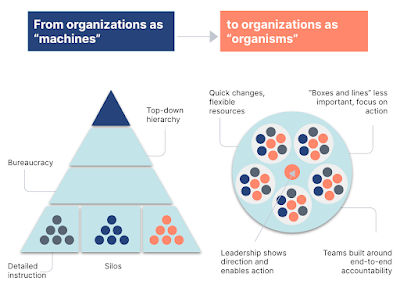
But what makes this possible and why can't traditional systems do the same? That is because traditional systems are monolithic, they are built on the premise of providing a business function that works the same for all. The same solution that can serve all industries, in all modalities, in all scenarios, with any equipment, and for all operators. They have to be implemented top-down with a lengthy implementation process that maps out all the requirements, scenarios and contingencies upfront. They require the adaptation of existing operational processes to what the system can support and in the way that it supports it. They provide standardized rigid hierarchical structures for representing manufacturing operations with a standard data model in a one-size fits all approach.  Monolithic systems are also designed for maintainability, meaning that they try to optimize to ease the maintenance and management of the solution by a team with specialized skillsets. 

Bottom Line! Monolithic Solutions rob your organization of rapid time to value and exponential productivity increases that is at the core of the digital transformation (Industry 4.0, Smart Factories, etc).  This may not be news to some but the reason I felt it was necessary to discuss this topic is because I see many companies adopting new digital technologies but then go happily down the path of recreating monoliths. A path that will inevitably result in what I call "Just Another X": JAM, JAL, JAW, JAC - Just Another MES, LIMS, WMS, CMMS, etc. These solutions that will at best be “just as good” as the other MES, LIMS, WMS, CMMS, etc., and will inherently have all the associated shortcomings.

A Composable solution is built from the bottom up in an iterative manner. It is inherently agile and adaptable and provides the most efficient way to digitize manufacturing operations. It provides a solution in which the manufacturing execution is organically integrated with the operations and business processes. It provides the most robust and effective way to increase productivity with a modern digital tools specifically a Frontline Operations Platform.

This is in stark contrast to a Monolithic approach where top down hierarchical process is used to provide a solution that fits within specific constraints that is hard to change. The goal is to fit the solution to the process in contrast to fitting the process to the solution. Composability removes the difficulties associated with adhering to complicated standards and systems. It frees the engineers to focus on rapidly building targeted apps that solve a specific problem, fit the process, and increases the rate of solution development by an order of magnitude.
  • Tailored specifically to each process, activity, operation - no compromises.
  • Instrumentation of each discrete process - capturing granular data about each activity
  • Complexity is distributed across the solution's Apps and easier to maintain
  • Highly adaptable and agile - easy to change, minimal impact to overall system behavior

This brings us back to Holonics and holarchies which explain the fundamental principle enabling agility and why monolithic system will never be able to support agility. We talk all day long about digital transformation but until we understand that the technologies we use have to enable these fundamental principles we will not get the promised order of magnitude productivity increases. Let me close with a quote from what was once the Agility Forum, one of the research initiatives that is the foundation for Industry 4.0: 
“Instead of building something that anticipates a defined range of requirements based on ten or twelve contingencies, build it so it can be deconstructed and reconstructed as needed.” 

                                                                                                   -Rick Dove, Agility Forum