Analytics header

Showing posts with label digital twin. Show all posts

Friday, September 12, 2025

A Composable Agentic Framework for Frontline Operations

Over the last year, “agentic AI” has shifted from emerging concept to practical conversation. Everyone is now talking about agents, and with today’s tools, building one has become every person’s business. But that raises a much bigger question: what agents should we build, and how do we organize them into something meaningful?

This is a topic that is not new and I have reflected on it through a number of lenses, e.g. Why IIoT is Transformative - its not the technology! and The Genius of the Toyota Production System Explained. This post however offers my first reflections on what a Composable Agentic Framework could look like for operations in general and manufacturing specifically. It’s an attempt to give industry an initial perspective, a concept and maybe some guidance for applying agentic AI to frontline operations in ways that improve both productivity and adaptability. Notice I say "initial", there is clearly much more to this topic that needs to be explored, discussed and debated - in addition the technology is nascent and we can expect much more sophistication and depth as it evolves.

Why Agents? Why Now?

For decades my peers and I, as manufacturing thinkers, have dreamed of holonic systems and fractal factories—production environments that adapt in real time, scale seamlessly, and continuously self-optimize. But until recently, that vision stayed in the realm of theory. The technology just wasn’t ready.

Now it is. Today’s digital platforms, IIoT connectivity, cloud infrastructure, and AI capabilities make it possible to realize this vision in practice. Instead of rigid, monolithic systems, we can now compose operations out of, and with, autonomous, collaborative agents that interact dynamically.

And this matters because composability is built on the idea that continuous, incremental improvements add up to transformation. What’s new is that agentic AI can accelerate these improvements beyond what we can imagine. Large language models and agentic frameworks have already proven their ability to supercharge productivity in domains like software development, research, and customer interaction. The challenge—and opportunity—before us now is to understand and define how to bring that same acceleration into composability and frontline operations.

Agents make this possible. Each agent is discrete, goal-oriented, and autonomous, yet designed to collaborate with other agents. When composed together, they create systems that flex, adapt, and continuously optimize.

In earlier posts, I’ve argued that digital transformation is not about IT and OT learning to coexist, but about creating a new whole where the distinction ceases to matter. That’s the essence of composability. Agents are the next step: a way to make that vision practical, modular, and scalable.

An Agent Framework for Composable Digital Solutions

The starting point is simple: in new digital operations platforms like Tulip, apps already behave like agents.

  • They have a clear goal (guide an operator, track a unit, log a machine event).
  • They operate autonomously within their context.
  • They collaborate with other apps and systems through shared data, triggers, and transitions.

Add AI into the mix, and these apps become agentic apps—supercharged digital teammates. And when multiple apps are composed together, they form a multi-agent system that mirrors the complexity of real operations, in other words they become digital twins in the true sense of the concept.

But in order for this "mirroring" to become a digital twin we need to define some rules and this is where the framework comes in. To move from scattered apps and automations to composable digital solutions, we need a structured way to think about agents.

Add AI into the mix, and apps evolve into agentic apps—supercharged digital teammates. Composed together, they form multi-agent systems that can mirror the complexity of real operations—becoming digital twins in the truest sense. But achieving that requires more than simply building agents; it requires structure and guidance. Without it, the risk is a proliferation of scattered apps and agents with no cohesive purpose—at best delivering little value, and at worst creating more complexity, reduced productivity, and even unsafe outcomes. The goal of this suggest framework is to provide the rules and design principles that ensure agents align toward a shared purpose. This reflects the essence of holonic structures: their power comes not just from autonomy, but from working together toward a common goal. That shared purpose is what makes them optimal, and what turns a collection of agents into a true composable digital solution that delivers measurable benefits.

In my earlier blog post “To Data Model or Not to Data Model”, I described the Artefact Model as a key element in composability: a scalable, flexible, interpretable representation of the operational system. The Artefact Model gives us the common context in which agents can interact—products, orders, machines, deviations, and operators all represented digitally and consistently.

A Perspective on Agent Types

Before diving into the types themselves, it’s important to recognize that agents serve two distinct scenarios in manufacturing:

Authoring / Building – Here, agents augment the creation process. They help engineers, developers, and even citizen builders design solutions faster and smarter. Think of them as co-pilots that propose app templates, generate artefact structures, suggest best practices, and automate repetitive setup tasks. These agents accelerate innovation and democratize solution-building.

Operations – Once deployed, agents act within day-to-day execution. They monitor machines, guide operators, coordinate workflows, manage deviations, and connect enterprise systems. These operational agents are the ones “living” in production, continuously working toward defined goals while collaborating with other agents and humans.

The framework presented here is focused specifically on the operations scenario. That being said there are commonalities and some agent types apply to both scenarios, but the context differs: in building, agents amplify human creativity and speed; in operations, agents amplify execution and adaptability. 

Agentic AI in operations enables a powerful ecosystem where "teams of experts" (agents) work together, demonstrating "collective intelligence". Crucially, operational agents, empowered by AI, transform what were once innate objects like machines and materials into active, intelligent members of the dynamic work environment. We are giving them the ability to be agents—autonomous and collaborative participants within the dynamic manufacturing operation network.

With that lets take a look at a shared taxonomy for the different types of agents in a composable agent framework:

Physical Agents: These agents are defined by their direct representation of physical manufacturing objects within the digital twin. They continuously mirror the real-world status, attributes, and behaviors of their tangible counterparts, enabling real-time monitoring, analysis, and control. Here are some examples:

  • Product Agent: Represents a specific product or unit throughout its manufacturing journey. Its goal is to track the product's individual status, quality parameters, and genealogy, providing a comprehensive digital record for each item produced.
  • Machine Agent: Serves as the digital twin of a specific piece of equipment or machinery on the shop floor. Its purpose is to monitor machine health, performance metrics (e.g., OEE, availability, performance, quality ), and predict potential failures, enabling proactive maintenance and optimized utilization.
  • Tote Agent: Represents a tote or device that carries and conveys product or material on the shop floor. This agent's role is to track the movement of the material or products it carrier in the operations and facilitates traceability and location with ease.

Operational Agents: These agents are defined by their focus on tangible operational entities and processes used in manufacturing management. They manage the flow of work, information, and events, ensuring that manufacturing processes adhere to plans and respond effectively to deviations. Here are some examples:

  • Order Agent: Represents a specific production or work order. Its goal is to oversee the end-to-end execution of that order, tracking progress against the schedule, managing material consumption, and ensuring all required steps are completed.
  • Deviation Agent: Activated when a process or quality deviation occurs. Its purpose is to identify, classify, and manage the deviation, potentially initiating corrective actions, alerts, or escalation workflows to relevant personnel or systems.
  • Schedule Agent: Responsible for dynamically managing and optimizing production schedules. This agent works to ensure resources are efficiently allocated and production targets are met, adapting to real-time changes in machine status, material availability, or order priorities.

System Agents: These agents are defined by their role in facilitating integration and intelligent interaction with broader enterprise-level systems and data repositories. They ensure data consistency, enable seamless workflow orchestration across different platforms, and provide access to critical business context. Here are some examples:

  • ERP Agent: Manages the flow of information between Tulip and the Enterprise Resource Planning system. Its function includes receiving work orders, reporting production updates, and managing material consumption and inventory levels in the ERP.
  • UNS Agent: Represents the integration with a Unified Namespace. This agent enables seamless, real-time data exchange across the entire operational landscape, ensuring that all systems have access to consistent and up-to-date information.
  • Data Lake Agent: Responsible for managing the ingestion of operational data from Tulip into a central data lake and enabling access to this data for advanced analytics and further AI model training. It ensures that the rich data captured by Tulip's composable applications is leveraged for broader insights.
  • Device Agent: Corresponds to a specific connected device, such as a scale, barcode scanner, or sensor. This agent's role is to facilitate seamless data exchange between the physical device and the Tulip platform, ensuring accurate data collection and enabling device-triggered actions.

Staff or Companion Agents. These are a general type of agent that augment the human's ability to find information, research topics, suggest improvements, and perform tasks. They are used in a variety of scenarios and serve as utilities in both the operational environment as well as the engineering or builder environments. Here are some examples:
  • Quality Research Agent: Quickly finds documentation, suggests troubleshooting steps to an operator, or summarizes a quality history for a supervisor.
  • App Builder Agent: Generates app templates, proposes table structures in the Artefact Model, or scaffolds connectors based on device specs—accelerating citizen developers and engineers.
What unites these agent types in this framework is the three core properties: it has a goal, it operates autonomously within a bounded scope, and it is collaborative—able to exchange data, signals, and intent with other agents and humans.

Crucially, these agent types do more than align with the Artefact Model — they enhance it. By consistent real time representation of artefacts (products, resources, orders, deviations), agents enrich the shared digital twin with actionable state, decisions, and provenance. That enriched Artefact Model becomes the lingua franca that lets agents interoperate reliably, enables composition, and prevents the classic failure mode: a landscape of scattered apps and ad-hoc bots with no unifying purpose.

In short: agents must be designed to work as an integral part of  the Artefact Model so that autonomy and collaboration add up to a cohesive, safe, and value-driving digital twin.

Beyond Incrementalism: The Future of Multi-Agent Collaboration Frameworks

Much of what we know about manufacturing improvements has historically been driven by incrementalism—step-by-step gains in efficiency, quality, or throughput. This mindset is not wrong; in fact, it is the foundation of continuous improvement and the heart of lean thinking. But incrementalism alone can only take us so far. To thrive in today’s volatile and complex operating environments, we need systems that don’t just get gradually better but can adapt dynamically to new conditions.

This is where multi-agent collaboration becomes transformative. Agents, by design, are autonomous but collaborative, and when they interact at scale, they exhibit something greater than the sum of their parts: collective intelligence.

The result is emergence and self-organization: a system-level intelligence and adaptability that was not explicitly programmed into any single agent. Emergent behavior is what allows multi-agent systems to flex and reconfigure in response to disruptions, market changes, or unexpected events. This is not just automation—it’s a new layer of operational intelligence applied directly to the frontline.

But to realize this potential, we must also reconsider the frameworks that structure our digital manufacturing systems. Such a composable, agentic world—where apps act as agents and operations are orchestrated by multi-agent systems—doesn’t fit neatly into traditional manufacturing systems standards and hierarchies definitions (see my earlier post, OK, Let’s Talk ISA-95).

That doesn’t mean throwing standards away, but it does mean rethinking or adapting them to this new reality. If emergence is the key to adaptability, then our models and standards need to evolve to describe systems that are dynamic, distributed, and composable rather than hierarchical and rigid.

In short: incrementalism is still essential, but it is no longer sufficient. Collective intelligence, powered by agents and guided by frameworks like the Artefact Model, is what will enable manufacturing to achieve adaptability at scale—and truly fulfill the promise of digital transformation.

Final Reflections

Building, authoring, creating agents is within everyone’s reach. But without structure and guidance, we risk ending up with a fragmented landscape of apps and bots—scattered efforts that deliver little value, or worse, add complexity, reduce productivity, and even create unsafe outcomes.

My hope is that this initial framework presented here provides that needed guidance. It should help us define what kinds of agents to build, how to compose them into systems, and how to ensure they align with a unifying purpose. It grounds agentic design in Composability and its Artefact Model, ensuring that agents not only adhere to but actively enhance the shared digital twin. This alignment is what keeps autonomy and collaboration from drifting apart and turns them into something greater: collective intelligence with emergent adaptability.

This is why composability and agent frameworks matter. They give us the structure to channel autonomy toward common goals. They offer to guide us on the path to increased productivity with adaptability. And they point to the need for new thinking in our standards and models—beyond the rigid boundaries of monolithic approaches, toward a more dynamic and composable reality.

In the end, the promise of agentic AI in operations is a the newest step in the digital transformation journey: Continuous Transformation - reinvention at scale of manufacturing operations.

And this is just the beginning. There is so much more to explore, define, and refine. I invite you—industry peers, practitioners, and thinkers—to engage in this discussion and debate. Let’s shape together what a composable agentic framework should look like in practice. After all, it takes a village... 

Tuesday, June 17, 2025

How Holonic Dreams are Becoming Manufacturing Realities

Let me tell you, there are few things more thrilling than seeing a concept you poured your heart into decades ago slowly coming to life in ways you barely dared to dream. For me, that feeling hits hard with the incredible capabilities of AI in general, and specifically, Generative AI . These aren't just buzzwords; they're fundamentally reshaping how we think about digital manufacturing (or whatever the latest term is). While Generative AI is phenomenal for creating content, designing new products, or even simulating complex processes, its true power in manufacturing often lies in its ability to empower something even more profound - Multi-Agent systems. This is the realization of Holonic concepts in a composable manner to enable agile manufacturing with Agentic AI .

When I see these advancements I am just mesmerized and my mind goes back to the 1990s. That’s when my journey into this future really began, deeply immersed in the world of Holonic Manufacturing Systems (HMS) and the emerging field of multi-agent systems.

Back then, I was a young researcher PhD working a methodology and architecture for Holonic manufacturing systems in collaboration with other like minded researchers as part of global consortium. It wasn’t just an academic exercise; it was a burning ambition to make manufacturing truly agile and resilient. I envisioned a factory floor that wasn't a rigid, top-down hierarchy, but a vibrant, decentralized network of intelligent, collaborative entities – what we called "holons."

The Holonic Vision: A Glimpse into the Future I Believed In

Imagine a shop floor where every machine, every production cell, every product, wasn't just a passive component but an intelligent "holon" – a self-contained, self-regulating unit. They would have their own smarts, making decisions, talking to each other, and collectively adapting to whatever curveball the market threw at them. Koestler's concept of a "holon" – simultaneously a whole and a part – perfectly captured this idea of distributed intelligence.

The benefits? Oh, they were clear and seemed a world away but yet an eerily anticipatory need of the current political and economic circumstances.
  • Agility beyond belief : Reconfiguring production lines in a flash, launching new products on a dime, responding to customer demands with unprecedented speed.
  • Built-in resilience : If one holon stumbled, the others would dynamically pick up the slack, re-routing operations to keep things flowing. Downtime issue would be a distant memory.
  • Seamless scalability : Adding new machines or processes would be like plugging in a new module, effortlessly integrating into the intelligent network.
  • Optimization from within : Local decisions by these smart holons would ripple up to optimize the entire system, far surpassing anything a central, rigid control system could ever hope to achieve.
This wasn't just theory; it was a blueprint for a manufacturing revolution.

We are Still Waiting for a Digital Manufacturing's Breakthrough

The holonic concept was the perfect architectural dream, but the engine to power it, multi-agent systems, was still in its infancy. My research in the 90's focused on how to design these agent systems, how to give them that holonic spirit, but the reality was that our ambition ran ahead of the available technology. We were hitting walls. The computational power needed to run complex agent logic on shop-floor controllers was simply astronomical for the time. Getting a multitude of agents to communicate reliably and securely across a factory? That was a networking nightmare. And then the AI capabilities were nascent, a whisper of potential, compared to the what we wield in our hands today."

Those were exhilarating times for pure research, pushing the theoretical limits of what manufacturing could be. But bringing it to large-scale industrial reality? That was a bridge too far. Until now ...

Today's Reality: AI and Digital Infrastructure can Unleashing the Holonic Dream

Fast forward to today, and the technological landscape has dramatically evolved. The convergence of several critical advancements has not only rendered the holonic vision achievable but has propelled it into operational realms previously unimaginable:
  1. Advanced AI and Machine Learning Capabilities : Modern Artificial Intelligence and Machine Learning algorithms now provide the sophisticated analytical and cognitive capabilities for individual software agents. These algorithms enable agents to learn from large-scale industrial datasets, execute robust predictive analytics with high precision, and achieve adaptive process optimization in real-time. This represents a fundamental shift from deterministic, rule-based systems to dynamic, self-optimizing intelligence.
  2. The Industrial Internet of Things (IIoT) as the Network of Agents, Powered by Agentic AI : This is where the core holonic vision finds its full realization. The Industrial Internet of Things (IIoT) is not merely a collection of connected devices; it forms the very network of agents. The IIoT nodes themselves are designed as autonomous, intelligent agents . Each smart device, each sensor, each piece of equipment can be made to act as a data acquisition point and, crucially, as a decentralized intelligent entity. The emergence of Agentic AI imbues these IIoT nodes with advanced capabilities for complex task decomposition, strategic planning, execution, and critical self-reflection. This synergy of IIoT as the foundational agent network and Agentic AI providing the cognitive layer directly mirrors the autonomous and cooperative principles fundamental to our original holonic concepts, enabling seamless interoperable collaboration across the manufacturing ecosystem. 

Futuristic Use Cases Becoming Reality: Empowering the Digital Twin for Tomorrow's Factory


For all these visions to truly become reality, we needed more than just powerful tech; we needed a concept that can effectively by applied to the realities of a physical operation. Here we can use a Digital Twin approach to represent the reality of the operation and build a foundational model with a set of constructs that aligned perfectly with the holonic principles I’d spent years researching.
This is also where Agentic AI enters the stage, becoming the intelligence that breathes life into this digital replica. My research from the 90s proposed a consistent model for these foundational constructs, embodying them as intelligent Product, Order, and Resource agents (or holons). This was the blueprint for how the real-world manufacturing elements could become autonomous, cooperative entities within the digital twin.

Let's step into this future for a moment, and I’ll paint a picture of what a manufacturing operation truly looks like when its digital twin is powered by these agentic principles, or in other words a next generation paradigm shifting composable manufacturing system . In this world, a work order isn't just data on a screen; it instantly awakens an intelligent Order Agent within the digital twin - or plainly the manufacturing system. This agent immediately gets to work, dynamically negotiating with Resource Agents —the digital representations of machines, tooling, even the specific human expertise required—to secure optimal production slots and materials in the virtual space, which then collaboratively drives actions in the physical factory assisting operators in orchestrating the operation.

As raw materials enter the facility, each component, or even the nascent product itself, manifests as a Product Agent within this digital twin. This agent carries its own unique digital identity and manufacturing instructions, literally guiding operators to route its counterpart through the physical production line. It's constantly communicating its status and needs within the digital twin, ensuring it receives the precise processing at each stage in the real world. If a specific machine (a Resource Agent ) suddenly reports a slight anomaly – say, a bearing starting to warm up – its built-in intelligence within the digital twin instantly flags it. Instead of waiting for a catastrophic failure, the line's collective intelligence, orchestrated by operators using the various software agents operating within this digital twin environment, might subtly re-route the physical Product Agent to an alternative, readily available machine. Or, better yet, the affected Resource Agent might even initiate a precise, self-healing routine or schedule a just-in-time, predictive maintenance intervention, ensuring that the issue is resolved before it impacts production, all while the Order Agent helps ensure deadlines are still met.

Quality control isn't a post-production check; it's baked into every micro-decision. Product Agents and Resource Agents , leveraging their digital twin data, are continuously monitoring parameters, spotting the tiniest deviation, and triggering immediate corrective actions to ensure "right first time". This seamless, autonomous orchestration – where products find their way, orders fulfill themselves, and machines manage their own well-being, all empowered through the precise, real-time fidelity of their digital twins – transforms the factory into a living, breathing, self-optimizing organism. It’s a level of agility, efficiency, and resilience that felt like pure science fiction in the 90s, but is now can become our tangible reality.

This leads us to an operational reality where the use cases that may seem futuristic are in fact possible , for example:
  • Self-Optimizing Production Lines : Imagine entire lines monitoring themselves, sniffing out bottlenecks, predicting breakdowns, and then autonomously re-routing production or tweaking parameters to keep output optimal. Empowering human operators with currently unimaginable support in orchestrating operations.
  • Dynamic Resource Allocation : Agents negotiating for machines, tools, and materials in real-time, ensuring every asset is utilized perfectly, eliminating idle time. Elevating scheduling and dispatching to unheard of levels of effectiveness and accuracy. 
  • Predictive Maintenance and Self-Healing Systems : No more waiting for a breakdown. Agents predict failures with incredible accuracy and can even kick off self-repair routines or proactive maintenance, slashing downtime and costs.
  • Enhanced Quality Control : Agents tirelessly monitoring processes and product quality, spotting deviations instantly and triggering immediate corrective actions. This is "right first time" manufacturing, every time.
  • Boosted Compliance : Automated data collection, precise procedure execution, immutable digital records – agentic systems dramatically reduce human error and guarantee adherence to the toughest regulations.
  • Unparalleled Traceability : Every single action, every decision by an agent, meticulously recorded. Audit trails become pristine, investigations swift and clear.
  • Driving "Right First Time" : By minimizing variability and providing real-time feedback, these systems help ensure products meet quality specs from the outset, slashing costly rework.
  • Accelerated Innovation : With more efficient, reliable processes, companies can pour more resources into R&D, bringing life-saving drugs or mission-critical components to market faster.
The journey from the elegant theories of holonic manufacturing systems to the practical, jaw-dropping capabilities of Agentic AI has been long, but intensely rewarding. What started as pure academic curiosity, exploring the power of decentralized, intelligent control, has now become the very bedrock of digital transformation in manufacturing. We’re no longer just imagining; we are actively building factories that learn, adapt, and optimize themselves , powered by the incredible, collaborative intelligence of software agents, physical machines, and empowered humans. It's a testament to the enduring power of fundamental research, a strategic commitment to true digital transformation, and the relentless, accelerating pace of technological innovation.

But hold on, not so fast. Here’s where my passion often turns to frustration. We have the technology today, and more is coming fast – innovation is accelerating at an exponential rate! Yet, a fundamental problem persists in manufacturing: so many companies still don't grasp that adopting digital technology demands a profound transformation , not just a simple upgrade.

The Agility Forum , a 1990 initiative to transform manufacturing, proclaimed that we need to thrive in an environment where change is the only constant. In today's volatile business landscape – marked by unprecedented geopolitical shifts, rapid market fluctuations, and increasingly fragile global supply chains – this is not longer a theory; it's the raw truth of survival. While our research in the 90s certainly anticipated a future of greater dynamism and the critical need for manufacturing systems to adapt , even we couldn't have fully foreseen the sheer velocity and breadth of the disruptions we face now.

This intense, continuous flux means leveraging that change, embracing agility itself, as your ultimate competitive advantage. The sheer ability to adapt, to pivot swiftly, and to continuously evolve your operations is precisely what will differentiate leaders from those left behind. In this dynamic landscape, digital transformation is not a static one time event, nor is it a project with a defined end; it is a continuous process of adaptation to changing business and technological environments - hence we need to start talking about Continuous Transformation .

The core issue isn’t the lack of innovative tools; it’s the mental, organizational, and cultural shift required to truly embrace them - yes its still really about people . Real digital manufacturing means rethinking everything – your processes, your workflows, even how you do business. It’s a complete reimagining, and that's precisely why the original holonic concepts, now enabled by modern tech, offer the inspiration for a breakthrough path. Embrace this paradigm shift, or risk being outmaneuvered by those who do. The future of manufacturing is intelligent, interconnected, and increasingly autonomous, built directly on the visionary concepts laid down decades ago.

Saturday, July 8, 2023

To Data Model or not to Data Model Part II - What to Data Model

The previous post about Data Models included a bit of a long winded discussion of why strict monolithic data models are not the alternative in the new paradigm. The main conclusion was that rather than focus on design of a strict data model for all of manufacturing lets step back and understand the problem that needs to be solved. The discussion is a bit theoretic and that is why I am compelled to go one level of detail deeper in an attempt to clarify some of the concepts. 

What do we need to help us in the transformation journey to maturity, how can we achieve Visibility, Transparency, Predictive Capacity and Adaptability? We need to shift the thinking from "what is the correct data model?" to "what do we need to become  predictive, and adaptable?". First of all we need more data, start digitizing your operation - the majority of the data we need is still on paper and diverse electronic documents and spreadsheets. Second, and this is the topic of this post, understand the informational elements of your operation and define a loose data dictionary that supports your digitization initiatives and citizen developers. With that and modern and emerging technologies for data analysis including AI/ML you will be able to gain the required insights and intelligence without a strict standardized monolithic relational data model. This will allow freedom within an organization for people to capture data without having to spend immense efforts in curating and micro managing how the data is stored and structured. Remember democratization and citizen development are a key enabler of digital transformation, their creative abilities with no-code technologies is the fastest way to digitize and instrument the operations. Get more digital data fast, its more important than how its structured and don't forget variety, multi media etc.

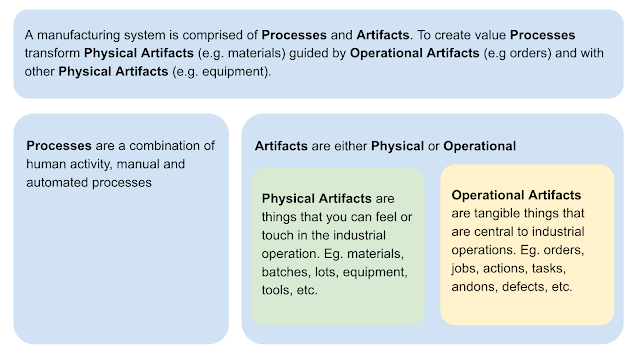
In my close to 30 years of studying the manufacturing domain it has become clear that there are just a few main and critical informational elements to a manufacturing operation. With that in mind I recommend an approach that uses generalization to help create transparency and interpretability but still allow for flexibility for specific use cases and varying degrees of complexity. The following generalization allows for a top down perspective into the complexity of a manufacturing operation. 


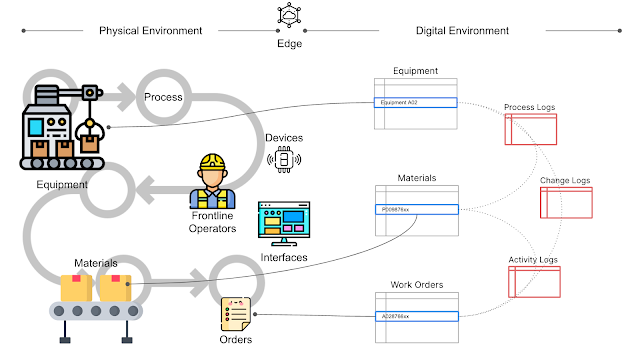
With this thinking, data about the artifacts represents the current status of each artifact, a single unique set of data (e.g. a row in a table). The processes that impact the artifact are captured in a historical record, a set of data for each significant transaction that transformed the state of the artifact (e.g. a running log). This results in a data set that represents real world artifact in a one to one relationship while everything that has happened to this artifact is captured in logs.  

If you create simple templates that allow contextualization of data at the source based on these simple rules you can with modern analytics tools rapidly get the insights that you need to mature digitally. I find that it works for both human driven analytics, from charting and graphing in Excel to Tableau, Sigma or whatever tool you prefer. Taking this even further you can super charge that with AI/ML driven analytics. I urge you to try, the good and easy thing is that the effort to build and use something like this with modern operational platforms is minimal compared to a building and using a complex relational data model. 

I also find that this model and generalization is a helpful tool to rapidly gain an understanding of a specific manufacturing operation. In fact I use it as a mental model when I do plant walk-thrus (Gemba walk) after which digital improvement ideas to observed operational challenges can be defined much faster and accurately. If you look closely many of the prevailing standards have the similar generalization but unfortunately have been overengineered past the point where they are practical.

Quickly understanding how a specific manufacturing system operates, from the machine to line and to the plant levels is the basis of digitization, its secret to gaining Visibility, Transparency, Predictive Capacity and Adaptability. Remember that is what we are after, the technology is just a means. If we can make it easier, more democratic, and adopted by the frontline masses then the network effect kicks-in and transformation happens faster, we gain productivity faster and we are well on our way to cross the digital divide.

Sunday, March 11, 2018

My head is in the Cloud

I have spent the last 2 months coming up to speed with SaaS, The Cloud, Big Data and advanced analytics. Wow, I am amazed at how far technology has come. In the last 7 years it seems I have moved further and further away from software technology with my increasing operational responsibilities. I did my best to follow the general trends and progress but really never in enough depth. I knew there was something “big” happening but kept thinking “I know what is going on…”, “I should have a general understanding…”. When I stopped to really understand how far some of these technologies, we group under the “Industry 4.0” umbrella, have come I found it quite astounding!

The power of artificial intelligence (AI) and machine learning (ML) algorithms that are able find patterns we never knew existed in vast amounts and use this information to predict future behavior is amazing. Stories such as the one where Target (the retail store) was able to identify a girl as pregnant before her dad knew, stand as proof. I have also found the ease at which data can send data to the Cloud is just hard to understand. We have been fighting the connectivity and data contextualization problem for such a long time that its hard to believe it can be done any other way. If we take a breather, step out of the ditch and take a look around then we can quickly realize - we don’t need to do this anymore! Data can be collected by software agents running on everything from a server to a sensor and configured through a digital twin. There is no need to format, convert, transform or contextualize the collected data. In fact the AI and ML algorithms work best if we keep it unstructured and the smaller the data sets the better.

This is all very exciting and the more I think about how we can use these technologies the more more encouraged I am that we can achieve true manufacturing intelligence. The ability to have a real time picture of everything that is going on in our manufacturing plant is simple and achievable. On top of that we can discover relationships between processes and artifacts that we never imagined existed, and use these to improve, to better operate, and maybe stop the great firefight that is operating a plant. We can transform the daily operational meetings to something akin of a weather forecast - wouldn’t that be something to watch?