Analytics header

Sunday, April 16, 2023

The Waste of not having Digital Data

My team started using Monday.com around a year ago. We needed a project management tool and Monday.com was our tool of choice. When I looked at it initially it seemed like any other project management tool, albeit cloud based and much more user friendly. Some may even consider it a glorified (or maybe more appropriately specialized) spreadsheet.   

I didn't think about it much, it was a PM tool and its use included the typical interaction as a project team member and for operational oversight. After a few month the team started showing graphs and charts based on the data that it captured. We could now easily see how long tasks take, how many project were over time, hours logged on projects, and more. As time progressed we had more and more data about our project execution and delivery operation. With that we started making better and more informed decisions such as optimizing teams, identifying risky projects, how many projects we are able to effectively run simultaneously, resource balancing, and much more. Then the team started putting in alerts, e.g. projects overdue, risk not being mitigated, and proactive actions. A year into using the tool we have now a services operations that is predictive and adaptable (this is a reference to the Industry 4.0 maturity model below) all on the merit of real time granular data that we is being captured just from us doing our job - without any extra or special effort in data collection.  

Industry 4.0 Maturity Model

Here is a tool that on first glance seems like just another PM tool. However since its a modern digital tool it instruments the project tracking and management process, capturing detailed data about every tasks and making that data intuitively available for all to use. That is the power of digitations, we see in all digital tools but it sometimes is lost on us when we reflect on something that we have done forever. For example Google, Facebook, Amazon all do this inherently - they capture granular data of everything. and with that data they are able to learn, improve and act.  This is what happens when you instrument your operation with a digital tool.

So if we take this as an example and reflect on any manufacturing operation it means that as a start we have to instrument and digitize. However the way this is approached in most manufacturing shop floors that I have experienced is by complicated data capture systems that require not only a immense effort in implementation but also constant battles from the frontline to use. Inputting data by the operator is typically an additional task they have to do, its not serving them any, it does it provide value to them and is essentially a form of waste. This results and data silos, or as how I like to call them "data puddles" that really do not provide much more than some isolated metrics. 

That of course is if there is any data capture at all! Many manufacturing operation are still operating with manual data and information in the form of paper, performance whiteboards, isolated spreadsheets, visual boards, etc. 

A compilation of photos from different shop floors I have visited.

We have to make the connection here, transforming digitally is not just another IT/OT exercise, its not a project you can execute to implement data capture technology (see post about crossing the digital divide). True digital technology is adopted not implemented, it starts by taking some manual task or operations and instrumenting them like Monday.com does for project execution. The first step in any digital transformation journey is to start to instrument your operation by providing digital tools to your operators that help do their job while at the same time collecting data - not the other way around. 

The interesting thing about doing it this way is that its in fact pretty easy, and at the same time seamless for your operations to adopt. Simply because it helps them do their job, and provide immediate feedback thru data visibility about their operation. It is how they become more productive, and productivity is what digital transformation is all about.  

With that in mind the simple way to start any digital transformation project is to do a Gemba walk to identify the waste of paper or no data. Find the places where instrumenting a process can provide a quick productivity increase. Instrument the process with a digital tool and see experience the boost yourself. Think of PDCA cycle with this level of granular and real time data. That is what digital transformation is all about.

Remember this can only be done by a digital tool that can be adopted (implemented, and used) with no specialized skills (democratized) and fast - within a few hours. Be warned a technology that does not provide these basic requirement, i.e. democratized and fast time-to-value, is not true digital (Industry 4.0) technology.

Sunday, April 9, 2023

How to Cross the Manufacturing Digital Divide

I find that there is a lot misguidance around what we in general frame up as the "fourth industrial revolution". I think most people accept that its real but have a hard time sifting through what digital technology is and is not. The biggest misconception is that any computerized system is digital technology, its like saying that steam and electricity are the same thing (this is a reference to the 1st and 2nd industrial revolutions). 

I like to use the term "digital divide" to emphasize the paradigm shift that is industry 4.0. The digital divide is like big great canyon (imagine the Grand Canyon). 


Imagine that you are standing on one side (industry 3.0) and need to cross over to the other side (industry 4.0) in order to gain the benefits of the new paradigm. This is quite a feat, not easy and not something that you don't just do - you can't just step over to the other side. It requires a concerted effort, conviction and of course means to take your company over to the other side. 

The problem here is that people have differing views of this digital divide (canyon) is. Some of course don't believe there is one, some think its a little crevasse they can step over, and then every variation of size from there on. Regardless of what you believe, the closer you get to the rim of the digital divide the more its true size becomes apparent. In other words its by trying to transform you learn how much of a paradigm shift Industry 4.0 is, however if you keep circling on the one side of the divide you will never know what is on the other side. I say that because there is much confusion and misguidance around what is and is not digital technologies. Many struggle to differentiate between the set of monolithic application such as MES, WMS, FMS, etc. that are foundationally the realization of the CIM concept, with the new agile app based platforms on cloud and edge architectures which are part of the new paradigm. It doesn't help that many of the concepts that we consider a paradigm shift and transformational have in fact existed for a while. The most common is AI, that has arguably been around for over 60 years and is now becoming pervasive, yes ChatGPT again... but in reality in many gadgets and things.  Another lesser known are multi-agent systems which is really at the core of IIoT and collaborative manufacturing equipment, i.e. collaborative robots. 
 
So what does the other side of the digital divide look like - what does a smart factory look like? It is a digitally transformed facility and operation that is reaping the benefits of increased productivity. Not just a step increase but in fact a factory that experiences an order of magnitude productivity gain! It is this productivity gain that comes with crossing the digital divide. It is what we need to aim and think about, when talking digital transformation. It must be the vision and the clear long-term goal and with a clear goal it is easier to prioritize which technology to try first and where or what to digitally transform first, in other words define a strategy that will take you across the canyon.

Although it may not be easy to paint a precise picture of what the future smart factory should look yet, it is possible to draw a picture of how such a smart factory behaves and operates, and what productivity increases to expect. Already in the 90s researchers were able to draw a picture of smart factories. This view can be reinforced with results from companies that have embraced the digital reality and relevant technological advances are already enjoying higher levels of productivity. What characterizes these companies is that they embraced a culture of change where adoption of new digital technologies is weaved into the continuous improvement processes. They have a "hacker" culture where digital native employees do not settle for aging monolithic systems, paper based processes, and antiquated methods.

This all means that we do need to seriously start changing cultures and adopting true digital technologies even if there not fully matured - because digital transformation is here! Call it what you want, Industry 4.0, Pharma 4.0 or Smart Manufacturing, its here, the future is now. Don't settle with rebranding your existing technologies, imagine if you went back to the future, would you still do things the same way? Transforming companies is may passion and it tickles me to see this unfold in industry - we dreamed about in the late 1990's!. 

So my advice is as follows:

Change is hard and takes time, understanding a new paradigm comes from adoption and experiencing tangible results - remember these results are not single digit improvement, the need to be "order of magnitude. Define a strategy that takes into account that interesting and valuable technological advances are still to come, embrace change and weave it into your strategy and culture. Get close to the rim of the canyon and get a good view of the other side! 

"Most people are afraid of change, but if you look at it as something you can always count on, then it can be a comfort." 
Robert Kincaid (Clint Eastwood)


Tuesday, February 5, 2019

The return of custom built manufacturing software

Is it really happening? Are the new digital technologies making it attractive and maybe even necessary to develop custom manufacturing systems solutions? For years we have advocated that companies focus on their core business competencies and leave the software development to expert best in class software companies. There are many horror stories of companies that are stuck supporting custom built software that is running their critical operations, why build and spend millions maintaining in house developed systems?

With the emergence of new digital technologies I see companies once again opting to develop custom software to solve their manufacturing systems needs. Is it because it is the 4th industrial "revolution", or is this truly something to consider, does it bring value and if so how? I believe there are a number of forces at play that are causing this to happen.
  • Emerging digital technologies specifically cloud based SaaS solutions provide user friendly ways to solve some specific problems like analytics and integration with very quick ramp-up times. I.e. you don't need a lot software development skills.
  • There is a real business need to get the promised productivity gains from these digital technologies. In other words organization have allocated money and people to get things moving in their digital transformation. 
  • The new generation of workforce comes from the digital age (i.e. digital natives) and are used to in simple words, just download an app for that. They are confronted with what they see as antiquated software systems that are not really user friendly and their reaction is to find another app.
  • The new digital technologies in general are human centered - they are developed to solve (and support) what we as people do, where as traditional business software is developed to automate a process.
  • The current solution landscape of available digital technologies, in what we know of as the manufacturing system domain, is very fragmented and somewhat immature. Yes there are pieces of it specifically in the Cloud part that are further along but in general no.   
So, is this a case of history repeating itself? Will we see a resurgence of home grown solution that we will in a few years pay dearly to replace with available software form industry suppliers? I am not going to try and be a futurist but I think we can apply some logic to what the future can bring.  So in general, yes I think so - although it will be different (what an ambiguous answer). There will be some level of custom software being built but at the same time there are some forces at play that are different from what we have seen in the past, and these will make a big difference.

The rate of software development and how fast it is maturing is much greater that it was in the past, and the new technological landscape will consist of a network (or mashups) of different systems.
We will not have specific monolithic systems for each department or business function. The future digital factory will be supported by a network of Cloud and Fog (or Edge Computing) software components that will have been put together from the bottom up. The future manufacturing systems will develop and mature over time thru emergence rather than a top-down design and development process. Think about that - if this is true so much of our current approaches will not work (GAMP, ISA-95/88, etc.)!

So much for my prediction of the future, PS no AI used here 😉.

Saturday, January 26, 2019

What is the Fog, and why does it matter?

Its not Karl the fog, but the industrial Fog! In news recently is the joining forces of the Industrial Internet Consortium® (IIC) and the OpenFog Consortium® (OpenFog). While manufacturers are still grappling with new technologies related to the new digital world (i.e Industry 4.0 and Smart Manufacturing) here comes another concept out of left field. So I guess the question is what is it and why does it matter right now, how will this bring me to the order of magnitude productivity increase.

Nobody said revolutions and transformation are easy, they require moving forward into the unknown - something us engineering have a really hard time with. Good news, there is no need to stress or move right now, but it is important to understand what it is. Especially when balancing existing needs served with exiting technologies while at the same time moving into the new paradigm. This is a common topic that I have been talking to many of you out in industry and hear the same frustrations: "We have to help the manufacturing operations today with technologies that we work while trying to figure out which digital technologies are ready for  prime tome now and which will take some more time to mature". Not sure how many people read this blog, but I wanted to try and give you my perspective.

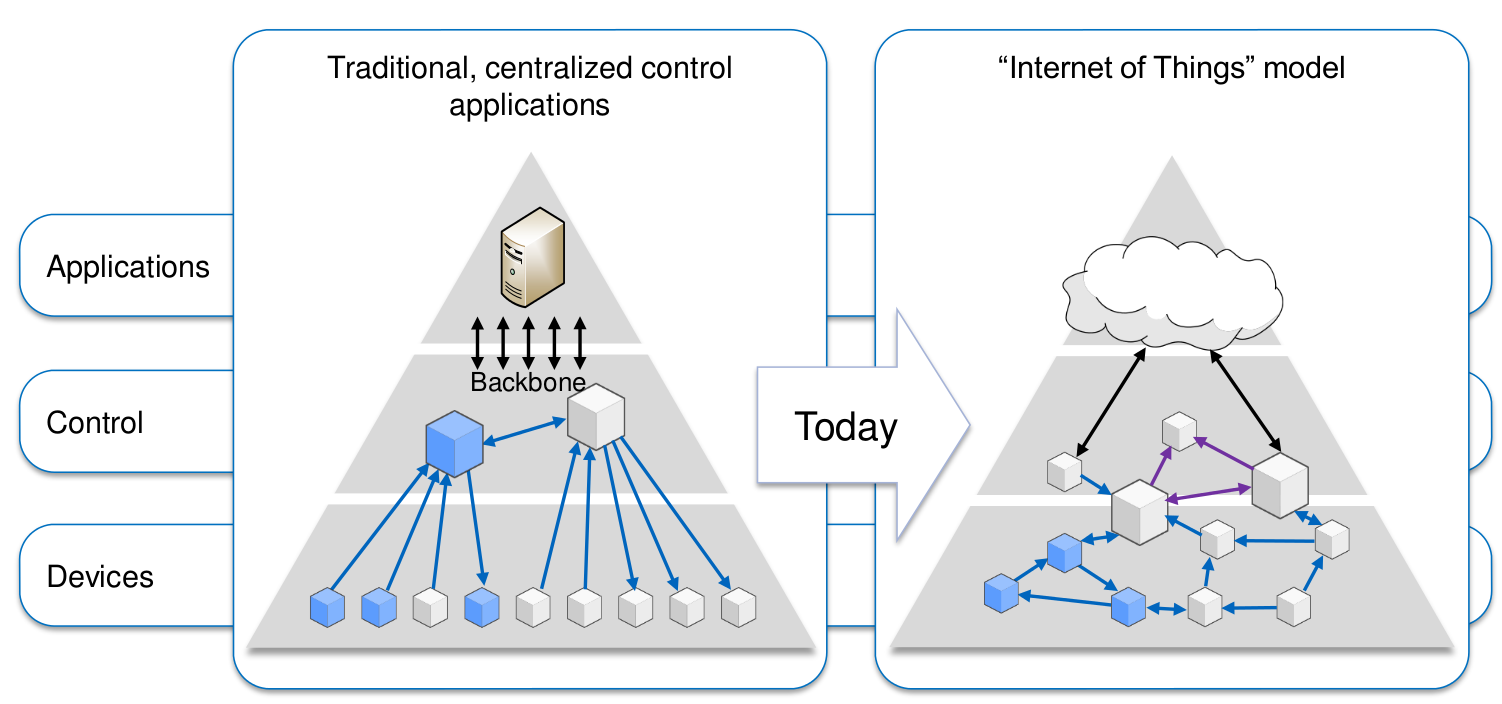
Although the main focus when talking about digital transformation is on people and use of emerging digital technologies such AI, Big Data, IoT, AR/VR, etc. It is important to understand that there is also a fundamental structural shift going on from a hierarchical systems approach to a distributed and collaborative human centered approach. The traditional approach to manufacturing systems design based on ISA-88 and ISA-95 hierarchical architectures which stem from a functional decomposition of the activities required for a manufacturing operation and process. These have served us well but in the future manufacturing operations landscape we will have a dynamic landscape of interconnected and collaborative edge or IIoT devices. They will not be top-down, command and control type architectures, which also put a question to the applicability of the current ISA standards to new digital manufacturing world!

In a Smart Factory the manufacturing system architecture will be more distributed yet not completely "flat". Digital technology takes a human centered approach that augments and support activities on the shop floor. The resulting architecture will be something that is called Heterarchy which in simple words mean a dynamic hierarchy. It is a networked structure that moves and changes with what is going on the production floor. Sounds real theoretical but in fact it is not, it is the same type of structure that we humans operate in every day. A system of independent components that work collaboratively toward a common goal or task. The figure below shows this in a simple graphic, notice the network of collaborative components in the "Internet of Things" model.

Image result for industrial internet of things model traditional
(from: The "Internet of Things" for industrial applications, Technical University of Munchen) 

So why is it called "Fog", they analogy comes from low clouds that make fog, i.e. bringing the Cloud closer to the edge you get fog - get it? So in the future IIoT and edge devices will not operate completely independently. They will collaborate and form local interconnected networks while using the Cloud as a form of supervisory level and a place to get a perspective on overall manufacturing states, long term predictions, and tasks that require more computing power. These dynamic networks in the "Fog" provides storage and applications that are distributed efficiently between the edge data source and the Cloud. Manufacturing data and information will be stored not only in the cloud but on the IIoT and edge devices in this "Fog". This is very important because in the new digital factory productivity gains will happen by making more intelligent decisions, and these decision will happen at the edge, i.e. on the production floor and not in the Cloud. Data in the Fog can be more accessible, more granular more real-time. Technologies will also allow use of this data, distributed as it may be, without needing to move it or transform it. Probably in the same way that we can visualize data that's in the Cloud today. 

Like I explained in the post about taking manufacturing back to the future the value is in the adaptability of the manufacturing operation that the Fog paradigm supports. Since the process behavior is dynamic and ever changing the only way to get consistent performance is by having adaptive control. Not only can adaptive control manage the ever-changing nature of the process’  internal and external factors, but it can also continuously learn, improve and thereby consistently increase performance and quality.

So this "Fog" concept seems scary and uncomfortable - and fog is in fact wet, cold and uncomfortable. Honestly, i am not that fond of the term either but I think its going to stick for a while. Maybe Holonic is a better term - dynamic and collaborative manufacturing systems and automation networks?