Analytics header

Monday, August 28, 2023

Why Pharma is primed to capitalize on Digital

Digital and GxP compliance - a topic that is in high demand and interest these days. The general skepticism and misunderstanding of people in the quality functions of life sciences manufacturing companies is simply put; the biggest barrier currently in digital adoption. I spend so much time explaining and trying to convey the potential in digital technologies and why they are much more compliant than any paper based documentation method. The paper mindset is a shackle that all pharma and biotech companies have to cut off, now and fast otherwise the implications are dire! And, this is not news; regulators know it, executives know it, operations know it, even the quality leadership in most companies know it. That is why such concepts and guidances as Pharma 4.0, Control Strategy, CSA, Continuous Validation, etc. are being introduced and advocated.  

The industries dependency on paper as a mean of documented evidence for compliance is so engrained that it more than a solution it has become weaved into the culture. The selected attempts to introduce electronic solution for compliance such as eBR, LIMS, QMS, etc have been so painful, expensive and unwieldy that they have left us grasping and finding comfort in the paper based solutions. This has left the industry is in a constant dilemma where we know we need to step into the digital era (the unknown) but feel most comfortable staying in warmth of the paper world (known). While some opt for the compromise of traditional systems as an alternative (another known). 

Pharma and Biotech operations and processes are inherently dependent on data. Unlike other industries where the products are physical and you can see problems and defects, the processes can in most cases only be seen or observed through data. Yet we choose to observe by capturing this data mostly on paper and resist the adoption of digital means - why? Because of preconceived notions of compliance and painful experiences with other systems? This is mind boggling - its like someone with poor vision refusing to get a pair of glasses or contacts with obscure excuses that its "not allowed" (reference to regulatory guidance).

In other manufacturing industries operational excellence is the only way to stay profitable. In the life sciences industries the profit margins allow some leeway in productivity levels but of course have the additional burden of compliance. It means that the opportunity to gain significant productivity improvements are very high, e.g. in the CPG industry productivity increase of less than 1% are welcome. In life science not many will make an effort for such a again. With that in mind think about "the waste of documentation" in most processes - I would venture to say that there is more than 10% productivity increase potential by digitizing all paper records across most operations. 

With this I am making a plea to all my peers in the life sciences manufacturing industries. Adopt a "digital anything" mindset and start the transformation. If you see a piece of paper being used that is your opportunity to start digitizing. It does not have to be an intricate complicated "system" that needs IT and top down approvals. Start small and digitize a paper a day, one paper at a time and you will become digital faster than you have ever imagined. Yes there are regulatory implication but do no use that as an excuse, start the digitization process where the skepticism (or maybe fear) is greatest, e.g. the QA or documentation departments.

If one thing you should take aways from the changing paradigm is that transforming paper to digital is not only a must but also significantly easier than it was in the past. I have said this many times, there are no excuses not to start adopting digital technology, and that means the improvements can be incredibly rewarding.  Eliminate paper there are easier way to capture evidence in the digital world!

Saturday, July 8, 2023

To Data Model or not to Data Model Part II - What to Data Model

The previous post about Data Models included a bit of a long winded discussion of why strict monolithic data models are not the alternative in the new paradigm. The main conclusion was that rather than focus on design of a strict data model for all of manufacturing lets step back and understand the problem that needs to be solved. The discussion is a bit theoretic and that is why I am compelled to go one level of detail deeper in an attempt to clarify some of the concepts. 

What do we need to help us in the transformation journey to maturity, how can we achieve Visibility, Transparency, Predictive Capacity and Adaptability? We need to shift the thinking from "what is the correct data model?" to "what do we need to become  predictive, and adaptable?". First of all we need more data, start digitizing your operation - the majority of the data we need is still on paper and diverse electronic documents and spreadsheets. Second, and this is the topic of this post, understand the informational elements of your operation and define a loose data dictionary that supports your digitization initiatives and citizen developers. With that and modern and emerging technologies for data analysis including AI/ML you will be able to gain the required insights and intelligence without a strict standardized monolithic relational data model. This will allow freedom within an organization for people to capture data without having to spend immense efforts in curating and micro managing how the data is stored and structured. Remember democratization and citizen development are a key enabler of digital transformation, their creative abilities with no-code technologies is the fastest way to digitize and instrument the operations. Get more digital data fast, its more important than how its structured and don't forget variety, multi media etc.

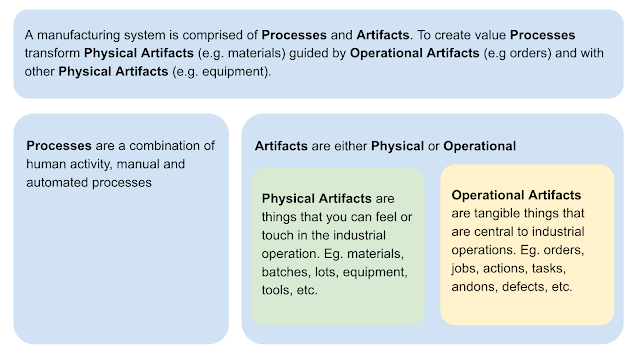
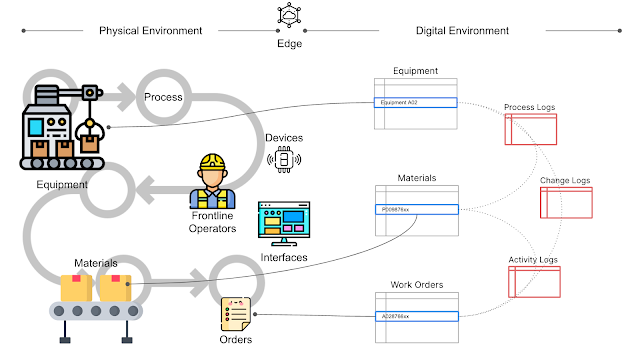
In my close to 30 years of studying the manufacturing domain it has become clear that there are just a few main and critical informational elements to a manufacturing operation. With that in mind I recommend an approach that uses generalization to help create transparency and interpretability but still allow for flexibility for specific use cases and varying degrees of complexity. The following generalization allows for a top down perspective into the complexity of a manufacturing operation. 


With this thinking, data about the artifacts represents the current status of each artifact, a single unique set of data (e.g. a row in a table). The processes that impact the artifact are captured in a historical record, a set of data for each significant transaction that transformed the state of the artifact (e.g. a running log). This results in a data set that represents real world artifact in a one to one relationship while everything that has happened to this artifact is captured in logs.  

If you create simple templates that allow contextualization of data at the source based on these simple rules you can with modern analytics tools rapidly get the insights that you need to mature digitally. I find that it works for both human driven analytics, from charting and graphing in Excel to Tableau, Sigma or whatever tool you prefer. Taking this even further you can super charge that with AI/ML driven analytics. I urge you to try, the good and easy thing is that the effort to build and use something like this with modern operational platforms is minimal compared to a building and using a complex relational data model. 

I also find that this model and generalization is a helpful tool to rapidly gain an understanding of a specific manufacturing operation. In fact I use it as a mental model when I do plant walk-thrus (Gemba walk) after which digital improvement ideas to observed operational challenges can be defined much faster and accurately. If you look closely many of the prevailing standards have the similar generalization but unfortunately have been overengineered past the point where they are practical.

Quickly understanding how a specific manufacturing system operates, from the machine to line and to the plant levels is the basis of digitization, its secret to gaining Visibility, Transparency, Predictive Capacity and Adaptability. Remember that is what we are after, the technology is just a means. If we can make it easier, more democratic, and adopted by the frontline masses then the network effect kicks-in and transformation happens faster, we gain productivity faster and we are well on our way to cross the digital divide.

Monday, June 26, 2023

To Data Model or not to Data Model

The ongoing debate about where and how MES fits in new era of digital technologies is raging. Its not surprising and in fact to be expected in any kind of change, basically the old guard vs the new guard. Of course you have to believe that the 4th industrial revolution is really a paradigm change. Something that I clearly align with and have some background to do so since I have been studying this phenomena since the 1990s.

As in other paradigm shifts there will always be a bit of the old that is part of the new. Steam power has not completely disappeared, it still relevant in specialized application but it is not the main source of energy powering industrial operations. This leads us to ISA-95 that I believe is a relic of the current "industry 3.0" era and not directly relevant in the new digital paradigm. (note I purposefully am trying to minimize the use of "Industry 4.0" since it starting to get a negative connotation with all the hype going on). But, that being said there are elements of ISA-95 and other best practices that may be relevant in the new paradigm, ie the old in the new?

If we let history be our teacher we can probably come up with some prediction and that is where the data model topic is interesting. ISA-95 includes a data model and all the established MOM solution include a data model that based on the available technologies at the time that seemed appropriate. The question is then; is the quest to achieve the nirvana of one standard monolithic data model for all manufacturing achievable and is it still relevant with the new digital technologies? The answer I think is clearly no and no, as far as I know there are very few, if any, examples of an organization achieving a real working standard data repository for all its operation and its not because of lack of trying.

The bottom line here is that striving for a single standard data model in a monolithic repository is a fools errand, regardless of if we try to implement it with modern digital technologies. That being said a common, shared and interpretable view of manufacturing operations is still needed and critical. In fact it's at the core of Industry 4.0, in that its the data and information that gives us the Visibility, Transparency, Predictive Capacity and Adaptability. This holistic view into the manufacturing operations is also at the core of the CIM concept from the 80s that advocated a common "shared knowledge" that all operational activities in plant uses in order to streamline to manufacturing of products. That means that both paradigms are aligned around the same challenge that to improve manufacturing operations we need to all have a common understanding and view into the operation!   

The CIM Enterprise Wheel (c)1993, SME.

The difference is how we achieve this common and shared view (information and knowledge). In the old paradigm it was the notion of a strict and rigidly structured data model, in the new paradigm we have relaxed these requirements to allow for analysis from both structured and unstructured data. I can hear the skeptics already; how can you gain any insights with different solution each having their own data structures? A few things to consider here: We do need context and this context should be defined at the source. We need to simplify data structures and get away from multiple levels of abstractions needed to run monolithic process driven solution.  Adhere to some simple shared guidelines using a consistent data dictionary that allows for flexibility within your organization. (I know this sounds overly simplistic and see part II of this blog post). With these principles we can adopt many of the modern digital tools to curate views into our data, on demand with the flexibility needed for common and personalized views and insights including of course AI.     

Let's take at an example where different solutions all represent some data about a lot of materials and its product code. The material can be referenced as Lot, Batch, Units, Pack, Kit, etc and the product code can be references as SKU, Item ID, Product, Material Number, etc. We of course immediately recognize these different names as similar because we understand how they are used. In the old paradigm we had to enforce strict rules in structure and semantics for software solution in order to visualize and analyze this data. That is however changing with new digital technologies and modern analytics platforms.  

It is also where AI can help, you see simply put AI is good at finding patterns. Its not that AI understands what the meaning of Item and Material Number is. It simply is looking for similarities in the relationship to other data structure and how its used to see that Item and Material Number really are very similar. With enough data volume and variety this can be easily detectable. Notice I said volume and variety this is where Cloud based system are important. Using isolated traditional monolithic system data sources will never get you to this point, even if they are lift and shifted to the cloud. You need a modern cloud native operational platforms that provides easy access to the their data that can be amassed and used to identifying these patterns.

I know there are a number of concepts discussed here and there may be some lack of depth in the discussion. I promised a follow up on this post with some more detail. But assuming this is true, just think about it. It means we can relax the strict data type and structure requirements and allow citizen developers to extend template data structures to create solution to solve operational problems and know that we can still gain valuable insights about operations, and again the more data we have to more insight we have. The conclusion here is: prioritize data volume and variety and not monolithic structures.

Sunday, June 11, 2023

4 Questions As a Guide Towards True Digital Transformation

Most people that have heard me talk about digital transformation are probably sick of hearing me talk about the "order of magnitude" productivity gain that is promised by the ongoing digital industrial revolution. But here again it is a key principle that can be used to understand transformation and navigate through the existing maze of confusion of what is and is not digital technology. Simply put digital technology is a technology that can directly impact industrial or manufacturing operations to bring about an order of magnitude productivity increase. 

I have compiled 4 critical elements that can help you sort through the maze of different technologies that are touted as digital, Industry 4.0 or Smart Manufacturing technologies based on this principle. These 4 elements can be framed as question that guide evaluation and selection of technologies:

Is it adopted and implemented in a "Bottom Up" manner?

Adoption and implementation are performed in an agile method, starting small in an iterative manner and building on outcome of each iteration. Agile approaches are an inherent part of the digital transformation and advocate a way to learn faster by short and rapid test-fail-learn cycles. The overall manufacturing systems solution is built from the bottom up in an iterative manner. 

This is in stark contrast to the traditional system approaches, including MES, where top down hierarchical processes are used to provide a solution that fits within specific constraints that is hard to change. There should be no "gap assessments", the technology is adapted to the process in contrast to fitting the process to the solution. It also removes the difficulties associated with adhering to complicated standards and systems. It frees engineers to focus on building solutions rapidly that fit the process and increases the rate of implementation by an order of magnitude (here I go again...). There are some interesting implications to this approach one of which is that Industry 3.0 standards such as ISA-95 becomes less relevant in this context.

Does it inherently support and enable Continuous Improvement?

Lean principles are still the most effective way to achieve productivity increases in an industrial operation and therefore the technology should be a tool to implement these operational improvements. The adoption of the technology should be done in a methodical PDCA or DMAIC cycle with each improvement supporting the next. Changes and modifications to a solution are easy and support iterative and constant improvement. The technology solutions are targeted at improvement areas with clear and quantified goals.   

It should be no surprise that regardless of the paradigm shift that is going on Lean and the principles of TPS are still real and valid. There is a close connection between the continuous improvement process and agile (bottom up) development approach of using the technology/solution. Th technology should be a Lean tool that allows engineers to rapidly iterate thru solutions to problem building digital content to an effective solution. 

Does it offer a Democratized approach and how does it enable "Citizen Developers"?

Users and implementors of the technology do not need to have unique and specific skills that are common for software, IT or automation engineers. Engineers and SMEs can rapidly adopt the technology to develop solution for the operations. The technology is so easy to use and learn that it is effectively accessible to most people with a basic level of technical aptitude. This allows the people that are closest to the process to craft solutions that are focused on solving a problem or provide an improvement. The technology should be adopted by people from within the operation rather than implemented by external parties.

Democratization and the citizen developer is an important aspect of the digital transformation. With modern digital technology we all can become builders of digital content. We already do this when using office tools such as Word and Excel and now we can even easily program our IoT door to open automatically when we get within range so we don’t have to take our key out. This is a big change compared to the high level of skills and expertise needed to build even simple automation tasks in traditional systems. No-Code/Low-Code is a key enabler of Democratization, it allows people with no programming or IT skills to build content that automates manufacturing processes in a simple and intuitive way. 

I find that for bigger organizations citizen development may be alarming, i.e. they feel it is akin to "arming the rebels". However there is no way around it, the benefits far outweigh the risks in this case and democratization of technology is key element of the new digital age. At the same time most of the new platform technologies provide accessible and transparent control and management of content being created and consumed. 

Is the technology able to provide Human Centric solutions?

The use of the technology should result in solution that serve humans or specifically frontline operators. It has to be intuitive, simple, easy to understand and easy to use. It has to serve the frontline operator by making him more productive, the operator is the key to the productivity gains promised by digital technologies in I4.0  

Modern digital technologies and tools are built on the principle of supporting human activity, that is what makes them so effective and so widely adopted. People are the key to unlocking productivity gains from digital technologies, that therefore have to focus on supporting human activity. The premise is that in order to increase productivity technology needs to support the human operator. In the new digital age manufacturing needs to enable the connected worker whose tasks are monitored and supported by a larger network of digital tools. In addition the technology should be used to capture additional digital data streams such as instrumentation of the human activity, the data that human operators collect, input they can provide about the process, and more. 

In conclusion, if a technology is not able to impact your operations in this significant way then its not digital technology - simply drop it from the list. Let's take a simple example: SaaS MES that is purportedly in the cloud and requires experts with specific skills set to configure and use with a 6+ months implementation time frame. This is not and example of digital technology. You should be seeing quantifiable productivity increase results within weeks of adopting any technology.  Another example is if the technology implementation requires a waterfall/phased method that requires design of the substantial parts of the solution upfront then it is not a digital technology!  

You can watch me talk about these topics on the Manufacturing IT Podcast with Daniel Langley.

Maybe this will also nudge the skeptics out there since speed, effort and real world double and triple productivity gains are becoming real and undeniable. Charlie Chaplin once said "if you look down, you will not see the rainbow".